Top 10 tips before considering any cosmetic surgery
1. Know your practitioner
Select a qualified, reputable practitioner to perform your procedure
and research that practitioner thoroughly. Find out how long they have
been practicing, what qualifications they offer, which areas or
procedures they specialise in, and you will slowly get an idea whether
they are the right doctor for you.
2. Meet them in person
It is crucial that you meet the doctor or surgeon who will carry out
your procedure before the day of your treatment. Rather surprisingly,
not all practices demand that patients meet the practitioner who will
deliver the procedure in advance. If you are advised that it is not
possible to meet in person with the doctor ahead of treatment, you
should not progress any further and choose to go elsewhere. Any
reputable practitioner will demand that they meet the patient themselves
beforehand. It is also important that you feel comfortable with your
doctor and that you trust them.
Tuesday, 30 July 2013

Cellulite
This condition is probably the bain of many a women's life.....
The underlying architecture of the subcutaneous fat is the cause of the visible change. There is herniation of fat deposits in between fibrous connective tissue strands. Almost like a honey cone where the honey represents the fat and the cone the fibrous septa.

I
get asked about solutions and treatments for this skin appearance on a
daily basis. It rears its head in many forms and severities from mild
dimpling to severe orange-peel effect.

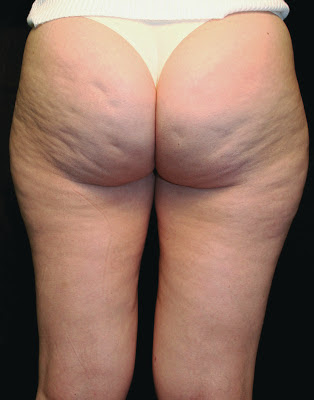
mild cellulite only on compression visible without compression
mild cellulite only on compression visible without compression
The underlying architecture of the subcutaneous fat is the cause of the visible change. There is herniation of fat deposits in between fibrous connective tissue strands. Almost like a honey cone where the honey represents the fat and the cone the fibrous septa.
CELLULITE is almost exclusively found in women, although occasionally seen in men on hormone treatment. We see it most commonly in post-pubescent women.
Scientific evidence is still scanty on the exact cause and related factors, but we know that oestrogen hormone plays a large role. Other factors include genetics, lifestyle, diet, weight (esp. raised BMI). Some of these factors we can obviously change, but others not.
Treatments
At this stage there are no specific treatments that can conclusively eliminate cellulite. External treatments that promise to eliminate cellulite are not very successful and result in many post-treatment tears and disappointment. The vital ingredient of any cellulite-busting treatment will be to remove the fibrous septae.
I am working on a novel treatment that is minimally invasive and involves separating the fibrous strands under local anaesthetic. The results look promising, but we are waiting for longer term results to offer this treatment confidently. WATCH THIS SPACE...........
Come see our website www.DrWolf.com
Tuesday, 18 June 2013
Visceral FAT and VASER
As the majority of my work consists of body contouring I see many patients that spend many months and even years in the gym trying to get rid of unwanted fat. This is often combined with healthy diet and lifestyle.
Occasionally patients have only recently changed their lifestyle and attitude towards exercise and become really frustrated when they see no change in their shape or contour. In many cases seeing a nutritionist (here is an excellent one by the way) can be of great value in tweaking your diet and eating routine. Most can also assess your food intolerances which may be contributing to the sensation of bloatedness and give you advice on combinations of foods. Money well worth spent.
If fat has accumulated over a few years then its most likely visceral fat. An excess of visceral fat
is known as central obesity, the "pot belly" or "beer belly" effect, in
which the abdomen protrudes excessively (see picture).

This body type is also known
as "apple shaped‚" as opposed to "pear shaped‚" in which fat is
deposited on the hips and buttocks (more commonly seen in women).
This is not in the superficial layer under the skin but fat that has been deposited around your organs (see figure below).
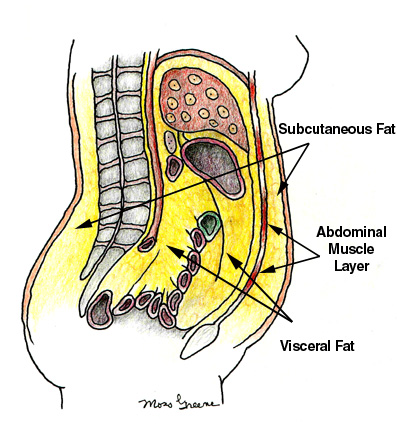
With any form of VASER, liposuction or fat removal this can only be performed in the subcutaneous fat layer. One cannot enter the abdominal cavity under the muscle.
This fat content unfortunately only responds to weight loss and changes in diet and lifestyle. And yes, it responds VERY SLOWLY and this is why many patients become so frustrated. When treating patients with significant amount of visceral it is imperative that they agree to make lifestyle modifications and diet changes. Subcutaneous fat removal can help and may speed up the loss of visceral fat, but only in conjunction with the above.
Visceral fat has many health implications. There is a strong connection to cardiovascular disease, diabetes, and dyslipidemia. Central obesity plays an important role in the impairment of lipid and carbohydrate metabolism shown in high-carbohydrate diets. Diet modifications and lifestyle CHANGES ARE THIS VITAL.
In summary, results are achievable, however, it is not easy and requires a combination of angles of attack. See what exercises are worth considering.....
Tuesday, 30 April 2013
Hand rejuvenation using autologous fat
When you are introduced to someone the first body part you engage with is the hands when you shake them.
One of the most common attributes of ageing is that we lose volume - be that in the face, breasts, buttocks or hands. Volume loss can make us look gaunt, and many people try maintain a certain weight to keep at a particular BMI. Unfortunately as we get older we have little control over the fat loss - lipoatrophy.
Most patients in tune with trying to keep younger looks concentrate on their face, neck and decolletage. Hands are often neglected and not seen as vital in maintaining.
We have started using lipo-filling or autologous fat transfer as a rejuvenation technique for the hands.
Most candidates have some fat they can donate for this purpose. The most common are we harvest from is the thighs, as we can harvest fat without leaving any visible asymmetry or disproportion. Alternative areas are - abdomen or flanks.
This procedure can obviously also be combined with larger liposuction techniques and added onto the end of the procedure.
On its own the procedure is performed under local anesthetic and takes approximately 1 hour. I tend to overfill the hands as some volume is lost over the first few weeks.
Recovery is very straight forward with only minor swelling of the hands. The harvest sites again remain swollen for 1-2 days and occasionally minor bruising does occur.
Click here for a recent article in the Daily Mail on fat transfer case I performed.


One of the most common attributes of ageing is that we lose volume - be that in the face, breasts, buttocks or hands. Volume loss can make us look gaunt, and many people try maintain a certain weight to keep at a particular BMI. Unfortunately as we get older we have little control over the fat loss - lipoatrophy.
Most patients in tune with trying to keep younger looks concentrate on their face, neck and decolletage. Hands are often neglected and not seen as vital in maintaining.
We have started using lipo-filling or autologous fat transfer as a rejuvenation technique for the hands.
Most candidates have some fat they can donate for this purpose. The most common are we harvest from is the thighs, as we can harvest fat without leaving any visible asymmetry or disproportion. Alternative areas are - abdomen or flanks.
This procedure can obviously also be combined with larger liposuction techniques and added onto the end of the procedure.
On its own the procedure is performed under local anesthetic and takes approximately 1 hour. I tend to overfill the hands as some volume is lost over the first few weeks.
Recovery is very straight forward with only minor swelling of the hands. The harvest sites again remain swollen for 1-2 days and occasionally minor bruising does occur.
Click here for a recent article in the Daily Mail on fat transfer case I performed.
Come see our website www.DrWolf.com
Update on MLD and foam inserts, compression garments after Lipo or VASER
Our experience in postop care has improved tremendously in the last few years. I suppose with the vast number of patients we are treating (I'm treating on average 9-12 patients a week) we come across all types of torsos and body types. This helps us understand many different types of healing and recovery times.
As all patients are different in terms of how rapidly they heal and can return to normal activity, we can give most patients an accurate idea of what to expect.
Our instructions on postop garment wearing has not changed much. Furthermore, the MLD routine has also not changed much. I think the awareness of MLD in the post lipo patient aftercare has become much more commonplace, although I still get the odd patient that comes to see me for advice after being treated elsewhere. This is usually in connection with what to do about lumpiness.
I have also started using foam inserts or vests which create a more even spread of pressure and compression. These pieces of foam are inserted between the garment and the skin (available from Macom-medical). They fill the negative spaces which are often not filled be the compression garment. Also, they tend to force upright posture which will prevent skin creasing which is an occasional concern in patients that have fluctuated in weight and have some skin laxity. See abdominal insert (top) and flank insert (lower). For any form of definition I create it is vital to use the full abdo insert vest which contours the negative and positive spaces.
As all patients are different in terms of how rapidly they heal and can return to normal activity, we can give most patients an accurate idea of what to expect.
Our instructions on postop garment wearing has not changed much. Furthermore, the MLD routine has also not changed much. I think the awareness of MLD in the post lipo patient aftercare has become much more commonplace, although I still get the odd patient that comes to see me for advice after being treated elsewhere. This is usually in connection with what to do about lumpiness.
 |
| Abdo insert |
 |
| Flank insert |
Come see our website www.DrWolf.com
Thursday, 31 January 2013
Update on Fat Transfer Breast Augmentation
One of the most sought after treatments we offer has been the Fat Transfer Breast Augmentation. In light of the PIP breast implant scandal women are seeking alternatives to implants.
In 2012 we saw a steep rise in fat transfer procedures- not only to the breast, but also the the hands and face. "FAT HAS BECOME THE NEW FILLER"- its your own tissue, you cant reject it, and it wont result in capsule formation or contracture. Furthermore, it is soft, feels like surrounding tissue and blends in with the natural shape and contour.
The most popular procedure was still breast augmentation (‘boob jobs’ using implants) but numbers dipped by 1.6%, from 10,015 in 2011 to 9,854 in 2012
Women had more fat-injecting than fat-removing procedures for the first time, with 2,641 fat transfer procedures compared with 2,638 liposuction ops.
BAAPS have also commented “Interestingly,
for the first time we see a greater number of women having procedures
to re-insert fat (known as fat transfer, to add volume to the face) than
to remove it, in the form of liposuction."
The most popular procedure was still breast augmentation (‘boob jobs’ using implants) but numbers dipped by 1.6%, from 10,015 in 2011 to 9,854 in 2012
Women had more fat-injecting than fat-removing procedures for the first time, with 2,641 fat transfer procedures compared with 2,638 liposuction ops.
Graft retention rates (the volume of fat that survives) have improved vastly. This is mainly due to healthier respect for the tissue and utilising different techniques. Using more volume has also allowed us to achieve slightly larger sizes than before.
Important is still to have very realistic expectations. These are not implants and thus sizes like DD and E are not achievable. Also many women require significant lifting of the breast and this procedure is not suited for that, although more projection of the breast is often achieved.
Important is still to have very realistic expectations. These are not implants and thus sizes like DD and E are not achievable. Also many women require significant lifting of the breast and this procedure is not suited for that, although more projection of the breast is often achieved.
Come see our website www.DrWolf.com
Cosmetic procedures 2012
I've been able to audit my 2012 figures as I keep a very accurate record of every procedure I do. This enables me to improve on my outcome and also track my performance in terms of patient satisfaction, percentage of male to females, ratio of various treatments etc.
In the UK on the whole the figures have jumbled a bit.
According to BAAPS “Interestingly,
for the first time we see a greater number of women having procedures
to re-insert fat (known as fat transfer, to add volume to the face) than
to remove it, in the form of liposuction. The growing appreciation that
facial ageing is more than just about the effects of gravity, combined
with scientific advances the rejuvenating qualities of stem cells
contained within fat help explain this trend. The Nobel prize for
medicine in 2012 being awarded to research in the field of stem cell
physiology suggests this may be an area of continued growth in the
future.”
Highlights:
- The most popular procedure was still breast augmentation (‘boob jobs’) but numbers dipped by 1.6%, from 10,015 in 2011 to 9,854 in 2012
- All anti-ageing procedures experienced a double-digit rise including face (up 14%) and brow (up 17%) lifts, eyelid surgery and fat transfer (both up 13%). Fat transfer to the face as taken the UK by storm.
- Male brow lifts went up by an impressive 19% from 125 to 149, facelifts up 14%, eyelid surgery by 11% and even fat transfer procedures to the face (to restore lost volume) by 10%
- Women had more fat-injecting than fat-removing procedures for the first time, with 2,641 fat transfer procedures compared with 2,638 liposuction op. We combine our VASER technique with fat transfer and thus achieve two results in one. Its become one of our most sought after treatment, especially as an alternative to breast implants.
- In contrast, demand for body-shaping procedures such as liposuction and tummy tucks tumbled by 14% and 12% respectively, for both genders combined
- Male breast (or ‘moob’) reduction surgery, possibly shunned in favour of new non-surgical approaches, was down by 18% - yet still maintained its place as the third most popular procedure for men. We have definitely seen a rise in male chest reductions. As we only perform the minimally invasive VASER technique it is much more attractive as a day case procedure.
- Male surgery overall fell by 4.5%, from 4,298 ops performed in 2011 to 4,102 in 2012, but men still account for roughly one in ten of all cosmetic surgery patients
Subscribe to:
Posts (Atom)