I get asked time and again about the aftercare following a VASER procedure. I thought it was thus time to write something about it. Ideally you should be reading this before the procedure so you know what to expect.
The recovery period is the most important part besides the actual procedure itself. Although I go through the aftercare at the consultation period and again immediately after the procedure, I suppose it cant be stressed enough. In most cases it is your first procedure and you are not really sure what to expect. Every patient will also retain and remember different points of the conversation.
I have actually made a video on this topic this passed weekend and hopefully, once edited, will add this to the post.
Immediately after the procedure you will be really padded up to absorb all the leakage. This will stay in place for the first 24hours.
If there is any leakage beyond the padding then its just necessary to add some more.
DO NOT REMOVE THE GARMENT in the first 24 hours.
I advise my patients to make sure they sleep on old towels and mattress protectors- this will prevent soiling of your bedlinen in case there is some leakage while you are sleeping.
We generally give you ample padding to take home, but it is worthwhile to have some more sanitary towel available.
The following morning I insist that you prepare for a shower. In preparation to remove the garment I advise that you lie on the bed or on the floor. Slowly open the clasps and remain in that position for a few minutes. This allows your blood pressure to normalise and prevent you from fainting and injuring yourself.
Remove all the soaked padding and discard it. Keep some gauze at hand so that any drips don't soil your carpet. Get yourself into the shower and have a gentle wash. Try not to rub any soap into the access points.
Once done, gently pat yourself dry. You may notice some leaking from the lower access points (pink stained fluid) which is normal. It is best to resume the lying position again. Place some small padding (size of the palm of your hand) onto the access points and close the garment again. During the day it will be necessary to replace the padding. The is will vary between patients, but a guide is really just when it gets soaked then replace it.
During the following days you will notice that the leakage will reduce to just a trickle and thus you can reduce the padding and the number of times it will need replacing.
Remain vigilant and keep a close eye on the access points. If you are worried, best to just call your treating surgeon for some advice.
READ THIS AGAIN so you know what to expect.
Have a look at this video for further clarification.....
Showing posts with label Vaser Hi Def. Show all posts
Showing posts with label Vaser Hi Def. Show all posts
Tuesday, 24 June 2014

Tuesday, 30 July 2013
Top 10 tips before considering any cosmetic surgery
Top 10 tips before considering any cosmetic surgery
1. Know your practitioner
Select a qualified, reputable practitioner to perform your procedure and research that practitioner thoroughly. Find out how long they have been practicing, what qualifications they offer, which areas or procedures they specialise in, and you will slowly get an idea whether they are the right doctor for you.
2. Meet them in person
It is crucial that you meet the doctor or surgeon who will carry out your procedure before the day of your treatment. Rather surprisingly, not all practices demand that patients meet the practitioner who will deliver the procedure in advance. If you are advised that it is not possible to meet in person with the doctor ahead of treatment, you should not progress any further and choose to go elsewhere. Any reputable practitioner will demand that they meet the patient themselves beforehand. It is also important that you feel comfortable with your doctor and that you trust them.
1. Know your practitioner
Select a qualified, reputable practitioner to perform your procedure and research that practitioner thoroughly. Find out how long they have been practicing, what qualifications they offer, which areas or procedures they specialise in, and you will slowly get an idea whether they are the right doctor for you.
2. Meet them in person
It is crucial that you meet the doctor or surgeon who will carry out your procedure before the day of your treatment. Rather surprisingly, not all practices demand that patients meet the practitioner who will deliver the procedure in advance. If you are advised that it is not possible to meet in person with the doctor ahead of treatment, you should not progress any further and choose to go elsewhere. Any reputable practitioner will demand that they meet the patient themselves beforehand. It is also important that you feel comfortable with your doctor and that you trust them.
Tuesday, 18 June 2013
Visceral FAT and VASER
As the majority of my work consists of body contouring I see many patients that spend many months and even years in the gym trying to get rid of unwanted fat. This is often combined with healthy diet and lifestyle.
Occasionally patients have only recently changed their lifestyle and attitude towards exercise and become really frustrated when they see no change in their shape or contour. In many cases seeing a nutritionist (here is an excellent one by the way) can be of great value in tweaking your diet and eating routine. Most can also assess your food intolerances which may be contributing to the sensation of bloatedness and give you advice on combinations of foods. Money well worth spent.
If fat has accumulated over a few years then its most likely visceral fat. An excess of visceral fat
is known as central obesity, the "pot belly" or "beer belly" effect, in
which the abdomen protrudes excessively (see picture).

This body type is also known
as "apple shaped‚" as opposed to "pear shaped‚" in which fat is
deposited on the hips and buttocks (more commonly seen in women).
This is not in the superficial layer under the skin but fat that has been deposited around your organs (see figure below).
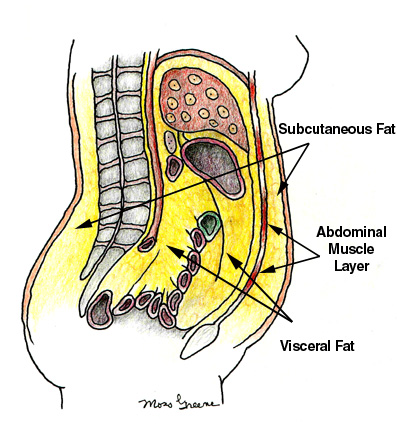
With any form of VASER, liposuction or fat removal this can only be performed in the subcutaneous fat layer. One cannot enter the abdominal cavity under the muscle.
This fat content unfortunately only responds to weight loss and changes in diet and lifestyle. And yes, it responds VERY SLOWLY and this is why many patients become so frustrated. When treating patients with significant amount of visceral it is imperative that they agree to make lifestyle modifications and diet changes. Subcutaneous fat removal can help and may speed up the loss of visceral fat, but only in conjunction with the above.
Visceral fat has many health implications. There is a strong connection to cardiovascular disease, diabetes, and dyslipidemia. Central obesity plays an important role in the impairment of lipid and carbohydrate metabolism shown in high-carbohydrate diets. Diet modifications and lifestyle CHANGES ARE THIS VITAL.
In summary, results are achievable, however, it is not easy and requires a combination of angles of attack. See what exercises are worth considering.....
Tuesday, 30 April 2013
Update on MLD and foam inserts, compression garments after Lipo or VASER
Our experience in postop care has improved tremendously in the last few years. I suppose with the vast number of patients we are treating (I'm treating on average 9-12 patients a week) we come across all types of torsos and body types. This helps us understand many different types of healing and recovery times.
As all patients are different in terms of how rapidly they heal and can return to normal activity, we can give most patients an accurate idea of what to expect.
Our instructions on postop garment wearing has not changed much. Furthermore, the MLD routine has also not changed much. I think the awareness of MLD in the post lipo patient aftercare has become much more commonplace, although I still get the odd patient that comes to see me for advice after being treated elsewhere. This is usually in connection with what to do about lumpiness.
I have also started using foam inserts or vests which create a more even spread of pressure and compression. These pieces of foam are inserted between the garment and the skin (available from Macom-medical). They fill the negative spaces which are often not filled be the compression garment. Also, they tend to force upright posture which will prevent skin creasing which is an occasional concern in patients that have fluctuated in weight and have some skin laxity. See abdominal insert (top) and flank insert (lower). For any form of definition I create it is vital to use the full abdo insert vest which contours the negative and positive spaces.
As all patients are different in terms of how rapidly they heal and can return to normal activity, we can give most patients an accurate idea of what to expect.
Our instructions on postop garment wearing has not changed much. Furthermore, the MLD routine has also not changed much. I think the awareness of MLD in the post lipo patient aftercare has become much more commonplace, although I still get the odd patient that comes to see me for advice after being treated elsewhere. This is usually in connection with what to do about lumpiness.
 |
| Abdo insert |
 |
| Flank insert |
Come see our website www.DrWolf.com
Tuesday, 4 September 2012

Thursday, 7 June 2012
VASER - MLDUK conference
I was kindly invited to give a talk at the MLD conference in May to share my experience of VASER and what recommendations I had for MLD therapists with regards to post-op treatment. The talk was fairly general with an overview describing the treatment and its indications to give the MLD fraternity an idea of what is achievable.
I was very surprised at how many therapists had come across VASER patients and had actually treated them; quite a number of them being my patients. I was very please to hear that I was one of the most active MLD supporters for VASER patients.
Traditional liposuction surgeons tend not to refer patients for MLD - not sure why? They are possibly unaware of the benefits.
The benefit that patients receive from having these treatments post-op is immense, not just in terms of reducing swelling and bruising, but also minimising subsequent risk of irregularities and lumps and bumps. Most patients will report softening of the tissue immediately post MLD. The treatment is also very relaxing and most therapists will show the patients self-help techniques they can perform at home on a daily basis.
There is significant scientific research to support the benefits of MLD in the post-op period.
As patients vary significantly in their healing phase the number of sessions required varies from individual to individual. Generally I would suggest starting with 3-5 in the first 2 weeks and then re-assessing the situation. Most practitioners will have one post-op review in that time and can then recommend further sessions if required.
For Hi Def patients the treatment regime is more intense and rigorous for the first 2 weeks (almost daily MLD sessions).
All in all it was a very interesting meeting with copious networking opportunities.
I was very surprised at how many therapists had come across VASER patients and had actually treated them; quite a number of them being my patients. I was very please to hear that I was one of the most active MLD supporters for VASER patients.
Traditional liposuction surgeons tend not to refer patients for MLD - not sure why? They are possibly unaware of the benefits.
The benefit that patients receive from having these treatments post-op is immense, not just in terms of reducing swelling and bruising, but also minimising subsequent risk of irregularities and lumps and bumps. Most patients will report softening of the tissue immediately post MLD. The treatment is also very relaxing and most therapists will show the patients self-help techniques they can perform at home on a daily basis.
There is significant scientific research to support the benefits of MLD in the post-op period.
As patients vary significantly in their healing phase the number of sessions required varies from individual to individual. Generally I would suggest starting with 3-5 in the first 2 weeks and then re-assessing the situation. Most practitioners will have one post-op review in that time and can then recommend further sessions if required.
For Hi Def patients the treatment regime is more intense and rigorous for the first 2 weeks (almost daily MLD sessions).
All in all it was a very interesting meeting with copious networking opportunities.
Friday, 27 April 2012
Lipedema- My VASER experience
My VASER experience
Six months ago I had never heard of
lipedema. As far as I was concerned, I was an overweight woman, with fat legs,
who in spite of 43 years of trying to lose weight, had never managed to do so.
In addition to being fat, therefore, I carried the burden of my self-perception
as being weak-willed and incapable of exercising control over my body, an
attitude that spilled over and profoundly influenced almost every area of the
rest of my life.
I had come to the Private Clinic because I wanted a breast reduction having heard about the miraculous Vaser technique, which seemed almost too good to be true: a short, minimally invasive procedure under local anaesthetic, which promised minimal downtime… However during the breast consultation I realized that this might also work for my fat legs and so it was, when Dr Wolf was assessing me for treatment, I first heard about lipedema.
It is not an overstatement to say that day was one of the most significant days of my life. Internet searches for lipedema yielded results that were simultaneously desperate, depressing, liberating and yet hopeful. Depressing and desperate because nine out of ten websites delivered the news that it was a chronic and incurable condition of unknown cause. Liberating because at a stroke I realized I was the victim, not the perpetrator, of my affliction (removing guilt at a stroke). And hopeful because one in ten sources mentioned Vaser, or tumescent liposuction: a new technique, which was apparently ‘transforming’ the lives of some lipedema sufferers.
It is hard to know where to begin to describe the experience of the last 4 months in which so many physical, psychological and emotional changes have taken place. I’ll begin with the experience of surgery itself: I have had 5 procedures in 4 separate operations over 4 months. The experience of Vaser itself is, as promised, short, minimally invasive, minimally uncomfortable and carried out by medical teams who are quite exceptional in terms of the quality of care, technical expertise and follow up treatment they provide. Within half an hour, a double chin I had hated since my teens, was removed. Within a further two hours, the breasts I had loathed since my early 40s, and which had ballooned since the menopause, were considerably reduced (the most marked result being that I no longer walk with a stoop, a life long affliction I had assumed was a spinal deformity). The tum which had grown since the menopause was radically reduced within 2 hours, and the same for thighs and calves (in addition to lipedema, the latter were very disfigured in an RTA I had when I was 17. Selective fat removal has rendered them almost symmetrical and looking far more like normal legs. Again, all under local anaesthetic and within the space of less than 2 hours).
At this juncture it is worth remarking on how, in just one patient, this extraordinary treatment has alleviated such a wide range of life-long afflictions, resulting from such various causes as the menopause, an RTA, the condition of lipedema and (in the case of my double chin) some unfortunate genes!
My recovery from each of these procedures has been very smooth. I liken the operations to rather long trips to the dentist (although unlike the dentist, you can chat!) and the recovery period is comparable with getting over a mild cold or having a period. I had to wear a compression garment for 2 weeks, take a course of antibiotics and have some (very enjoyable!) MLD. Post-operative pain was minimal and alleviated with an occasional paracetamol.
Visually, I look very different. I never wanted to be a catwalk model or an athlete – that’s not what I wanted from my body – but I now look OK, and looking OK is not something I take for granted! Having spent over 4 decades feeling I was deficient and abnormal, looking OK is a HUGE thing for me, and precisely what I wanted to achieve. I used to think I didn’t fit in and my physical problems were in the foreground of people’s perception of me. Now I look in a mirror and am happy with what I see, which means I can get on with my life and my relationships with other. I’m OK!
Looking OK, means that the psycho-emotional jumble of self-deprecating thoughts and feelings have been defused. It is impossible to overstate just how significant this is. It is fair to say that even if I hadn’t had Vaser, the guilt about my condition would have gone, at a stroke, with Dr Wolf’s diagnosis. But with Vaser I find I am more psychologically outgoing. Unconsciously, as the condition took hold and became compounded, post-menopause, with larger breasts and tum, I had let friendships lapse: I have now picked up the threads of some treasured old friends and have many social events planned, which I would otherwise have avoided.
I don’t quite know where the energy has come from. Yes, I have lost bulk and feel more psychologically inclined to move and be active, but the resultant energy seems above and beyond these causes. Whatever the cause, this has been a fantastic result and find I DO so much more of everything – gardening, housework and so on. With the increased activity is a further enhanced sense of wellbeing. At one point I was doing so much that my son asked if anything was the matter with me, so unaccustomed is he to having an active mum!
The Vaser results have given me a huge boost, which I am building on with changes in lifestyle. I am learning more about lipedema and eating better, plus taking regular exercise. I recognize that these choices will support my overall health now and into the future.
Speaking of which, in 2 days time I will arrive at the milestone of my 60th birthday with all that that bespeaks. I shudder to think how I would have felt at this juncture in my life, had I not discovered Vaser. My physical condition would have been unaltered, and I would have hovered in that horrible hinterland of guilt, desperation and false hope. I now feel as though my life has just begun. I have the energy and self-confidence to face the future with enthusiasm, excitement, curiosity and a sense of physical and mental well-being. It is true to say that I feel healthier, in every sense, than I felt at any of my other milestone birthdays.
I cannot recommend Vaser too highly and while I realize that results doubtless vary with the individual, dependent on all sorts of factors, not least patient expectations, I am happy for my results to be used to help others who are in a similar position to where I found myself 6 months ago.
I had come to the Private Clinic because I wanted a breast reduction having heard about the miraculous Vaser technique, which seemed almost too good to be true: a short, minimally invasive procedure under local anaesthetic, which promised minimal downtime… However during the breast consultation I realized that this might also work for my fat legs and so it was, when Dr Wolf was assessing me for treatment, I first heard about lipedema.
It is not an overstatement to say that day was one of the most significant days of my life. Internet searches for lipedema yielded results that were simultaneously desperate, depressing, liberating and yet hopeful. Depressing and desperate because nine out of ten websites delivered the news that it was a chronic and incurable condition of unknown cause. Liberating because at a stroke I realized I was the victim, not the perpetrator, of my affliction (removing guilt at a stroke). And hopeful because one in ten sources mentioned Vaser, or tumescent liposuction: a new technique, which was apparently ‘transforming’ the lives of some lipedema sufferers.
It is hard to know where to begin to describe the experience of the last 4 months in which so many physical, psychological and emotional changes have taken place. I’ll begin with the experience of surgery itself: I have had 5 procedures in 4 separate operations over 4 months. The experience of Vaser itself is, as promised, short, minimally invasive, minimally uncomfortable and carried out by medical teams who are quite exceptional in terms of the quality of care, technical expertise and follow up treatment they provide. Within half an hour, a double chin I had hated since my teens, was removed. Within a further two hours, the breasts I had loathed since my early 40s, and which had ballooned since the menopause, were considerably reduced (the most marked result being that I no longer walk with a stoop, a life long affliction I had assumed was a spinal deformity). The tum which had grown since the menopause was radically reduced within 2 hours, and the same for thighs and calves (in addition to lipedema, the latter were very disfigured in an RTA I had when I was 17. Selective fat removal has rendered them almost symmetrical and looking far more like normal legs. Again, all under local anaesthetic and within the space of less than 2 hours).
At this juncture it is worth remarking on how, in just one patient, this extraordinary treatment has alleviated such a wide range of life-long afflictions, resulting from such various causes as the menopause, an RTA, the condition of lipedema and (in the case of my double chin) some unfortunate genes!
My recovery from each of these procedures has been very smooth. I liken the operations to rather long trips to the dentist (although unlike the dentist, you can chat!) and the recovery period is comparable with getting over a mild cold or having a period. I had to wear a compression garment for 2 weeks, take a course of antibiotics and have some (very enjoyable!) MLD. Post-operative pain was minimal and alleviated with an occasional paracetamol.
Visually, I look very different. I never wanted to be a catwalk model or an athlete – that’s not what I wanted from my body – but I now look OK, and looking OK is not something I take for granted! Having spent over 4 decades feeling I was deficient and abnormal, looking OK is a HUGE thing for me, and precisely what I wanted to achieve. I used to think I didn’t fit in and my physical problems were in the foreground of people’s perception of me. Now I look in a mirror and am happy with what I see, which means I can get on with my life and my relationships with other. I’m OK!
Looking OK, means that the psycho-emotional jumble of self-deprecating thoughts and feelings have been defused. It is impossible to overstate just how significant this is. It is fair to say that even if I hadn’t had Vaser, the guilt about my condition would have gone, at a stroke, with Dr Wolf’s diagnosis. But with Vaser I find I am more psychologically outgoing. Unconsciously, as the condition took hold and became compounded, post-menopause, with larger breasts and tum, I had let friendships lapse: I have now picked up the threads of some treasured old friends and have many social events planned, which I would otherwise have avoided.
I don’t quite know where the energy has come from. Yes, I have lost bulk and feel more psychologically inclined to move and be active, but the resultant energy seems above and beyond these causes. Whatever the cause, this has been a fantastic result and find I DO so much more of everything – gardening, housework and so on. With the increased activity is a further enhanced sense of wellbeing. At one point I was doing so much that my son asked if anything was the matter with me, so unaccustomed is he to having an active mum!
The Vaser results have given me a huge boost, which I am building on with changes in lifestyle. I am learning more about lipedema and eating better, plus taking regular exercise. I recognize that these choices will support my overall health now and into the future.
Speaking of which, in 2 days time I will arrive at the milestone of my 60th birthday with all that that bespeaks. I shudder to think how I would have felt at this juncture in my life, had I not discovered Vaser. My physical condition would have been unaltered, and I would have hovered in that horrible hinterland of guilt, desperation and false hope. I now feel as though my life has just begun. I have the energy and self-confidence to face the future with enthusiasm, excitement, curiosity and a sense of physical and mental well-being. It is true to say that I feel healthier, in every sense, than I felt at any of my other milestone birthdays.
I cannot recommend Vaser too highly and while I realize that results doubtless vary with the individual, dependent on all sorts of factors, not least patient expectations, I am happy for my results to be used to help others who are in a similar position to where I found myself 6 months ago.
CM, Shropshire, April 2012.
Come see our website www.DrWolf.com
Tuesday, 6 March 2012
VASER treatment areas in male and female patients
Alternative, non-invasive liposuction techniques have been developed to treat smaller areas of adipose deposit. The collection of anatomical areas has remained fairly consistent over the last few years in both male and female patients.
Our figures confirm this - for males the most popular treatment area is still the abdomen and chest (gynecomastia) and flanks. Males tend to limit themselves to these areas as they have only really become aware of the cosmetic industry in the last few years. As treatments become more available and less invasive our male patients will undoubtedly look at other treatment areas.


Our figures confirm this - for males the most popular treatment area is still the abdomen and chest (gynecomastia) and flanks. Males tend to limit themselves to these areas as they have only really become aware of the cosmetic industry in the last few years. As treatments become more available and less invasive our male patients will undoubtedly look at other treatment areas.
For females the most popular treatment areas remain the abdomen, flanks, outer thighs (saddle bags) and gluteal fold. For women the most troublesome areas are the midriff and the outer thighs. These respond well to VASER with most patients achieving very good results.
Audit Figures of VASER Gender distribution 2011
I've looked at all the VASER cases I performed last year and audited the figures. Interesting stats to say the least. On the whole female patients still form the bulk of my clientele. Male patients have certainly become more aware of their aesthetic requests and demands. Industry figures correlate with these stats nationwide. I think males are becoming less critical and less averse to cosmetic procedures and are realising that there is nothing wrong with looking after one-self.


Wednesday, 29 February 2012
Skin Laxity after VASER
Many patients, in fact all patients, will during some stage of a consultation ask about skin laxity. Most will mean they are concerned about skin wrinkling or having rolls of skin hanging from their torso.
In my experience it is fairly easy to assess whether a patient will react well to the VASER treatment and suffer from lax skin or not. If there is any doubt that there is going to be wrinkly skin then the patient is not a candidate and I decline to treat them.
The term "Loose skin" applies to the mobility of the skin. This occurs when the interface between the muscle and skin becomes less elastic and allows the skin to move freely over the muscle and connective tissue. As we become older our elastic tissue becomes a little lax and thus allows for the skin to be a little more mobile.
This becomes especially noticeable when someone has lost a few stones. Compare this to a ballon that deflates - the membrane becomes flaccid as the volume depletes. Similarly the skin becomes a little "wobbly" over the muscle. VASER does help a little with skin tightening, but there is a limit as to how much will take place.
I hope this explains and reassures you a little with regards to skin laxity.
In my experience it is fairly easy to assess whether a patient will react well to the VASER treatment and suffer from lax skin or not. If there is any doubt that there is going to be wrinkly skin then the patient is not a candidate and I decline to treat them.
The term "Loose skin" applies to the mobility of the skin. This occurs when the interface between the muscle and skin becomes less elastic and allows the skin to move freely over the muscle and connective tissue. As we become older our elastic tissue becomes a little lax and thus allows for the skin to be a little more mobile.
This becomes especially noticeable when someone has lost a few stones. Compare this to a ballon that deflates - the membrane becomes flaccid as the volume depletes. Similarly the skin becomes a little "wobbly" over the muscle. VASER does help a little with skin tightening, but there is a limit as to how much will take place.
I hope this explains and reassures you a little with regards to skin laxity.
Come see our website www.DrWolf.com
Thursday, 9 February 2012
VASER Hi Def - before and after
I saw another VASER Hi Def patient yesterday. The procedure was performed in June last year.
One of the important aspects of having this treatment is being willing and able to maintain the result. Its not a quick fix at all. Ideally prospective candidates should be relatively fit and already have a fair amount of contour. The procedure is aimed at pronouncing the contour and definition.
I see many patients that see themselves as very fit, but are not suited for the procedure. This can be due to a variety of reasons:
lax skin, too many stretch marks, musculofacial laxity (when the skin is very mobile), too much visceral fat (fat around the organs), clear inability or lack of motivation of not being able to maintain the result.
Understandably many patients are disappointed if I tell them that they are not suitable for the VASER Hi Def procedure. It all boils down to being honest and realistic. There is no point in trying to attempt to perform the procedure on a patient that is not suitable. Firstly its unethical from a medical standpoint, secondly the patient will not be satisfied, and thirdly, one will be trying to correct what one cannot achieve.
There are many before and after pictures available on the net that are good examples of patients that were not suitable for the VASER Hi Def procedure.
The procedure needs to be tailored to the individual patient. Thats where the 3D "vision" comes in. Visualising the anatomical landmarks and underlying muscles is of paramount importance. Hence its easier to treat patients that have a fair amount of muscular definition already. It is although not impossible to visualise these under a thinnish fat layer. Also important is input and feedback from the patient prior to the procedure. Some patients don't want specific types of the definition and its important to specify this at the marking stage. I always get my patients to look at their marking and make sure they are in agreement with the style of definition. Before pictures of the markings will then also confirm this.
Below is a picture of another content patient who has managed to maintain his result.......


Click here to see a video on VASER, its indications, how it works and what it can achieve.
;
One of the important aspects of having this treatment is being willing and able to maintain the result. Its not a quick fix at all. Ideally prospective candidates should be relatively fit and already have a fair amount of contour. The procedure is aimed at pronouncing the contour and definition.
I see many patients that see themselves as very fit, but are not suited for the procedure. This can be due to a variety of reasons:
lax skin, too many stretch marks, musculofacial laxity (when the skin is very mobile), too much visceral fat (fat around the organs), clear inability or lack of motivation of not being able to maintain the result.
Understandably many patients are disappointed if I tell them that they are not suitable for the VASER Hi Def procedure. It all boils down to being honest and realistic. There is no point in trying to attempt to perform the procedure on a patient that is not suitable. Firstly its unethical from a medical standpoint, secondly the patient will not be satisfied, and thirdly, one will be trying to correct what one cannot achieve.
There are many before and after pictures available on the net that are good examples of patients that were not suitable for the VASER Hi Def procedure.
The procedure needs to be tailored to the individual patient. Thats where the 3D "vision" comes in. Visualising the anatomical landmarks and underlying muscles is of paramount importance. Hence its easier to treat patients that have a fair amount of muscular definition already. It is although not impossible to visualise these under a thinnish fat layer. Also important is input and feedback from the patient prior to the procedure. Some patients don't want specific types of the definition and its important to specify this at the marking stage. I always get my patients to look at their marking and make sure they are in agreement with the style of definition. Before pictures of the markings will then also confirm this.
Below is a picture of another content patient who has managed to maintain his result.......


Come see our website www.DrWolf.com
Click here to see a video on VASER, its indications, how it works and what it can achieve.
;
MLD after VASER lipo
I thought I would you some insight into what is required in the post-operative period of VASER.
Besides wearing the compression garments it is also important to have manual lymphatic massage.
The duration that you will wear the garment depends on the practitioner. Each will have their own preference. My patients wear the first line garment for 2 weeks 24/7 (taking it off for washing etc), then for another 3-4 weeks about 10 hours a day. Best is to wear it during the day as at night most of the oedema (swelling) will settle so its not as effective.
MLD has only really been introduced in the post-operative period in the past 2-3 years. Many traditional, old school plastic surgeons still don't see the benefit in the treatment.
I have noticed a tremendous improvement in the speed of recovery, minimising swelling, softening of tissue, minimising bruising and general improvement in comfort.
The number of sessions that are required is variable. My feel is that one cannot have enough MLD. Obviously finances are a limiting factor.
Here is a rough guide as to the average number of session:
arms - 3
abdomen - 5-10
flanks - 5-10
outer + inner thighs - 3-5
chin/face - 3-5
In Hi Def patients this may rise to 15-20 sessions (remember that these are just guidelines and your Dr may recommend more or less)
As I said it is variable from patient to patient and also depends on your level of activity. Most patients getting back into gym and exercise usually require less sessions.
MLD therapists can be found on the www.MLDUK.ORG.UK website. Make sure they are registered or otherwise they may be using traditional massage techniques which are not appropriate. The treatment is very gentle, almost like stroking. It should not be uncomfortable - if it is then its being done incorrectly.
Try and see the therapist that the Dr recommends as they generally have a good relationship and give each other feedback on how the patients are doing. Thereby concerns are flagged up early and can be dealt with immediately. Many therapists have gotten to know me now due to the many referrals and anticipate the treatment regime I recommend. Some have even come to seek VASER treatment themselves after seeing the dramatic results and the snappy recovery of their patients.
The procedure kickstarts the lymphatic system back into action. With all the fluid that is infiltrated for the local anaesthetic the tissue becomes a bit overwhelmed with the tissue load and struggles in reducing this. Once the sustain is complete majority of the fluid has been aspirated out. However, tissue swelling soon starts and results in a little swelling. Occasionally some lumps and bumps appear too. These again respond very well to MLD.
Hope that gives you a little more insight into MLD and VASER treatments.
Have a look at this video for more clarification......
Bye for now.
Dr Dennis Wolf
Besides wearing the compression garments it is also important to have manual lymphatic massage.
The duration that you will wear the garment depends on the practitioner. Each will have their own preference. My patients wear the first line garment for 2 weeks 24/7 (taking it off for washing etc), then for another 3-4 weeks about 10 hours a day. Best is to wear it during the day as at night most of the oedema (swelling) will settle so its not as effective.
MLD has only really been introduced in the post-operative period in the past 2-3 years. Many traditional, old school plastic surgeons still don't see the benefit in the treatment.
I have noticed a tremendous improvement in the speed of recovery, minimising swelling, softening of tissue, minimising bruising and general improvement in comfort.
The number of sessions that are required is variable. My feel is that one cannot have enough MLD. Obviously finances are a limiting factor.
Here is a rough guide as to the average number of session:
arms - 3
abdomen - 5-10
flanks - 5-10
outer + inner thighs - 3-5
chin/face - 3-5
In Hi Def patients this may rise to 15-20 sessions (remember that these are just guidelines and your Dr may recommend more or less)
As I said it is variable from patient to patient and also depends on your level of activity. Most patients getting back into gym and exercise usually require less sessions.
MLD therapists can be found on the www.MLDUK.ORG.UK website. Make sure they are registered or otherwise they may be using traditional massage techniques which are not appropriate. The treatment is very gentle, almost like stroking. It should not be uncomfortable - if it is then its being done incorrectly.
Try and see the therapist that the Dr recommends as they generally have a good relationship and give each other feedback on how the patients are doing. Thereby concerns are flagged up early and can be dealt with immediately. Many therapists have gotten to know me now due to the many referrals and anticipate the treatment regime I recommend. Some have even come to seek VASER treatment themselves after seeing the dramatic results and the snappy recovery of their patients.
The procedure kickstarts the lymphatic system back into action. With all the fluid that is infiltrated for the local anaesthetic the tissue becomes a bit overwhelmed with the tissue load and struggles in reducing this. Once the sustain is complete majority of the fluid has been aspirated out. However, tissue swelling soon starts and results in a little swelling. Occasionally some lumps and bumps appear too. These again respond very well to MLD.
Hope that gives you a little more insight into MLD and VASER treatments.
Have a look at this video for more clarification......
Come see our website www.DrWolf.com
Bye for now.
Dr Dennis Wolf
Subscribe to:
Posts (Atom)