I was fortunate enough to attend the Lipoedema conference on the 24th June in Reading this year. It was well attended and very informative for networking and sharing experiences with other professionals.
It was re-iterated that not much information was available for patients with the condition and still many GP are misdiagnosing the condition as obesity. The training course offered by Lipoedema.co.uk has however had overwhelming response from GPs in getting the word out.
Many GP are now recognizing the condition and referring patients in the right direction.
Some interesting data were produced by a German clinic on the success of tumescent liposuction including VASER and the treatment of Lipoedema. It remains the only real way of preventing the condition from worsening especially when caught in the early stages (stage I or II).
Stage III requires more interventional treatments such as skin excision and reconstruction.
The key is to diagnose it in the early stages and manage it appropriately. This includes MLD and wearing hosiery.
www.Lipoedema.co.uk
www.MLDuk.org.uk
http://www.lipedema-simplified.org
Henrietta@MLDLondon.co.uk
Showing posts with label bodysculpting. Show all posts
Showing posts with label bodysculpting. Show all posts
Thursday, 21 July 2016

Thursday, 19 May 2016
3000 VASER liposuction procedures!!!
I am pleased to be able to share with you that I have just recently performed my 3000th case of liposuction using the VASER.
Due to patient confidentiality we could not share this publicly, but the patient was pleased to be able to celebrate this milestone with us.
We did however take a celebratory "Team" photo.

Looking forward to the next 1000!!!
DrWolf.com
DrDennisWolf.blogspot.co.uk
YouTube DrWolf.com channel
Tuesday, 30 September 2014
2 hour surgery time slots are a No,No - alarm bells should ring
I've had a few patients see me recently for a consultations for various treatments that have had consultations at other clinics.
A common question I get asked is how many 2 hours slots will be required, or if we work in other time limited surgery slots.
I am amazed that doctors actually try and work and perform treatments limited to time slots.
A procedure should be performed to its completion regardless of how long it takes. If the doctor is limited by time then there is a good chance that the procedure is either rushed or incomplete. This will results in poor results or complications.
Remember that you are not paying for the time, but for the complete procedure and result. The doctor should not be limited by a 2 hour time slot.
I thus advise that any clinic that performs surgery in limited time slots should be avoided.
Have a look at my YouTube channel DrWolf.com for some really informative videos.
A common question I get asked is how many 2 hours slots will be required, or if we work in other time limited surgery slots.
I am amazed that doctors actually try and work and perform treatments limited to time slots.
A procedure should be performed to its completion regardless of how long it takes. If the doctor is limited by time then there is a good chance that the procedure is either rushed or incomplete. This will results in poor results or complications.
Remember that you are not paying for the time, but for the complete procedure and result. The doctor should not be limited by a 2 hour time slot.
I thus advise that any clinic that performs surgery in limited time slots should be avoided.
Have a look at my YouTube channel DrWolf.com for some really informative videos.
Tuesday, 24 June 2014
VASER post op aftercare
I get asked time and again about the aftercare following a VASER procedure. I thought it was thus time to write something about it. Ideally you should be reading this before the procedure so you know what to expect.
The recovery period is the most important part besides the actual procedure itself. Although I go through the aftercare at the consultation period and again immediately after the procedure, I suppose it cant be stressed enough. In most cases it is your first procedure and you are not really sure what to expect. Every patient will also retain and remember different points of the conversation.
I have actually made a video on this topic this passed weekend and hopefully, once edited, will add this to the post.
Immediately after the procedure you will be really padded up to absorb all the leakage. This will stay in place for the first 24hours.
If there is any leakage beyond the padding then its just necessary to add some more.
DO NOT REMOVE THE GARMENT in the first 24 hours.
I advise my patients to make sure they sleep on old towels and mattress protectors- this will prevent soiling of your bedlinen in case there is some leakage while you are sleeping.
We generally give you ample padding to take home, but it is worthwhile to have some more sanitary towel available.
The following morning I insist that you prepare for a shower. In preparation to remove the garment I advise that you lie on the bed or on the floor. Slowly open the clasps and remain in that position for a few minutes. This allows your blood pressure to normalise and prevent you from fainting and injuring yourself.
Remove all the soaked padding and discard it. Keep some gauze at hand so that any drips don't soil your carpet. Get yourself into the shower and have a gentle wash. Try not to rub any soap into the access points.
Once done, gently pat yourself dry. You may notice some leaking from the lower access points (pink stained fluid) which is normal. It is best to resume the lying position again. Place some small padding (size of the palm of your hand) onto the access points and close the garment again. During the day it will be necessary to replace the padding. The is will vary between patients, but a guide is really just when it gets soaked then replace it.
During the following days you will notice that the leakage will reduce to just a trickle and thus you can reduce the padding and the number of times it will need replacing.
Remain vigilant and keep a close eye on the access points. If you are worried, best to just call your treating surgeon for some advice.
READ THIS AGAIN so you know what to expect.
Have a look at this video for further clarification.....
The recovery period is the most important part besides the actual procedure itself. Although I go through the aftercare at the consultation period and again immediately after the procedure, I suppose it cant be stressed enough. In most cases it is your first procedure and you are not really sure what to expect. Every patient will also retain and remember different points of the conversation.
I have actually made a video on this topic this passed weekend and hopefully, once edited, will add this to the post.
Immediately after the procedure you will be really padded up to absorb all the leakage. This will stay in place for the first 24hours.
If there is any leakage beyond the padding then its just necessary to add some more.
DO NOT REMOVE THE GARMENT in the first 24 hours.
I advise my patients to make sure they sleep on old towels and mattress protectors- this will prevent soiling of your bedlinen in case there is some leakage while you are sleeping.
We generally give you ample padding to take home, but it is worthwhile to have some more sanitary towel available.
The following morning I insist that you prepare for a shower. In preparation to remove the garment I advise that you lie on the bed or on the floor. Slowly open the clasps and remain in that position for a few minutes. This allows your blood pressure to normalise and prevent you from fainting and injuring yourself.
Remove all the soaked padding and discard it. Keep some gauze at hand so that any drips don't soil your carpet. Get yourself into the shower and have a gentle wash. Try not to rub any soap into the access points.
Once done, gently pat yourself dry. You may notice some leaking from the lower access points (pink stained fluid) which is normal. It is best to resume the lying position again. Place some small padding (size of the palm of your hand) onto the access points and close the garment again. During the day it will be necessary to replace the padding. The is will vary between patients, but a guide is really just when it gets soaked then replace it.
During the following days you will notice that the leakage will reduce to just a trickle and thus you can reduce the padding and the number of times it will need replacing.
Remain vigilant and keep a close eye on the access points. If you are worried, best to just call your treating surgeon for some advice.
READ THIS AGAIN so you know what to expect.
Have a look at this video for further clarification.....
Tuesday, 18 June 2013
Visceral FAT and VASER
As the majority of my work consists of body contouring I see many patients that spend many months and even years in the gym trying to get rid of unwanted fat. This is often combined with healthy diet and lifestyle.
Occasionally patients have only recently changed their lifestyle and attitude towards exercise and become really frustrated when they see no change in their shape or contour. In many cases seeing a nutritionist (here is an excellent one by the way) can be of great value in tweaking your diet and eating routine. Most can also assess your food intolerances which may be contributing to the sensation of bloatedness and give you advice on combinations of foods. Money well worth spent.
If fat has accumulated over a few years then its most likely visceral fat. An excess of visceral fat
is known as central obesity, the "pot belly" or "beer belly" effect, in
which the abdomen protrudes excessively (see picture).

This body type is also known
as "apple shaped‚" as opposed to "pear shaped‚" in which fat is
deposited on the hips and buttocks (more commonly seen in women).
This is not in the superficial layer under the skin but fat that has been deposited around your organs (see figure below).
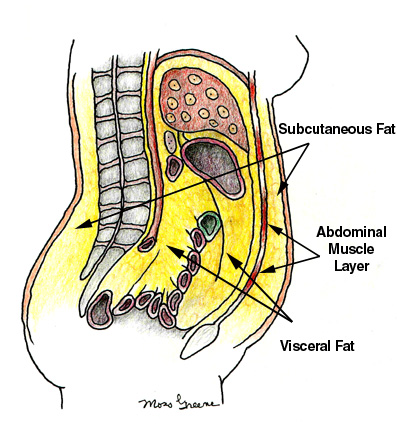
With any form of VASER, liposuction or fat removal this can only be performed in the subcutaneous fat layer. One cannot enter the abdominal cavity under the muscle.
This fat content unfortunately only responds to weight loss and changes in diet and lifestyle. And yes, it responds VERY SLOWLY and this is why many patients become so frustrated. When treating patients with significant amount of visceral it is imperative that they agree to make lifestyle modifications and diet changes. Subcutaneous fat removal can help and may speed up the loss of visceral fat, but only in conjunction with the above.
Visceral fat has many health implications. There is a strong connection to cardiovascular disease, diabetes, and dyslipidemia. Central obesity plays an important role in the impairment of lipid and carbohydrate metabolism shown in high-carbohydrate diets. Diet modifications and lifestyle CHANGES ARE THIS VITAL.
In summary, results are achievable, however, it is not easy and requires a combination of angles of attack. See what exercises are worth considering.....
Tuesday, 19 June 2012
Fat Transfer Breast Augmentation (Natural Breast Enlargement)
The History of Breast Augmentation
Breast augmentations are one the most common female cosmetic procedures performed. In 2010 the USA performed 13 million cosmetic procedures (ASPS). Of these, 300'000 were breast augmentations. The majority of these were Silicone based implants followed by Saline filled implants.
The first breast implant procedure was performed 50 years ago. The patient, Timmie Jean Lindsey, now 80 years, was very please with the result and the implants are still "alive".
Fat Transfer Breast Augmentation (autologous fat transfer)
The Procedure
Risks
Although the procedure is done as a day case it is still a surgical procedure and thus needs to be treated as such. Risks such as infection, abscess formation, bleeding, asymmetry, fat necrosis, fat cysts are important to bear in mind. The fat retention volume is somewhat unpredictable, but presently rates of 50-70% are achieved. This will vary from patient to patient and there is the risk that almost all the fat will be lost.
One of the most important possible side effects is the occurrence of calcifications. When fat does not survive it may form small spicules of calcium that are visible on mammograms. Calcifications are sometimes associated with suspicious lesions on mammograms and often require further investigations and tests. When supplemental imaging modalities are considered such as digital mammograms or MRI scans calcifications from fat necrosis can be distinguished from the malignant signs of irregularly shaped, high-opacity micro calcifications. It is to be remembered that not all fat graft procedures will result in calcifications.
Of the thousands of fat grafts performed to date there has not yet been a case reported of a missed cancer diagnosis on mammogram due to a fat graft procedure.
Numerous scientific papers have since been published on the topic (Fulton, 2003; Spear, 2005; Missina, 2007; Carvajal, 2008; Illouz, 2009; Hiko, 2009; Delay, 2009; Da Li, 2009; Veber, 2011; Cong Feng, 2011; Claro, 2012) and the conferences are full of presentations on techniques, experiences, outcomes and imaging modalities for cancer screening purposes.
Recently an american author has undergone a cell enriched fat graft to the breast after having a large lump removed (http://tinyurl.com/d6jjmn8).
The largest followup series of fat grafts has been reported by Illouz and Delay looking at over 1000 patients over a 10 year period respectively. Although there has been heated debate about whether fat graft to the breast will interfere with the interpretation of mammograms the ASPS position paper indicated "no evidence that fat injections interfere with breast cancer detection and that results of fat transfers remain highly dependent on a surgeon’s technique and expertise".
Over the last 30 years the industry has evolved immensely. Numerous implant manufacturers have come and gone and surgical techniques have been improved on and modified.
The first implants were silicone based and subsequently other types have come onto the market including soya based and saline filled implants.
Currently the most common type of implant used is Silicone. The choice of implant used depends on the desired shape and size the patient requires and also on surgeon preference.
Other augmentation procedures that exist are musculo-cutaneous flaps (muscle and skin grafts; DIEP, TRAM, Lattissimus dorsi) that are taken from one area and transposed to another. These are mainly used for reconstruction purposes for cancer survivors. Occasionally surgeons also use tissue expanders to create an envelope and then insert an implant.
With the cosmetic industry being flooded with dermal fillers the aesthetic company Q-Med launched a product called Macrolane (Hyaluronic Acid filler) which was used as a body contouring filler. It is a degradable product which is injected into a pocket underneath the breast tissue and is used to enhance the size and shape of the breast. It is also used as filler for buttocks, calves and male pecs. The product lasts approximately 9-12 months and then the procedure can be repeated. At present the license for breast remodelling has been revoked until a consensus can be agreed upon for screening modalities in women with the filler. The product is still used for general body contouring. There are no safety issues regarding the product.
Fat Transfer Breast Augmentation (autologous fat transfer)
With the current PIP scandal many women are looking for other alternatives to formal surgery and implant procedures. Autologous fat transfer or fat graft is fast becoming a popular choice. The first breast fat graft was performed by an american surgeon and described in the American Journal Plastic and Reconstructive Surgery in 1987. There was a big uproar by his fellow surgeons as there was not enough scientific evidence to support the procedure, its consequences and risks.
However, in 2007 Sydney Colemen, a major proponent of fat graft procedures, suggested that it was "time to end the discrimination created by the 1987 position paper" and " judge fat grafting to the breast with the same caution and enthusiasm as any other useful breast procedure."
The Procedure
The surgeon will usually do a psychological assessment to ascertain the suitability of the patient and gain insight into the patients' expectations. The patient then also needs to be assessed for suitability in terms of fat content and breast suitability. Pre-operative imaging is important to assess symmetry, volume, shape and also for comparison postoperatively.
Fat is harvested via a liposuction technique and filtered to get rid of any unwanted material such as local anaesthetic, blood, connective tissue etc. Many women see this as a 2 in 1 procedure as they have fat removed from areas that they don't like and at the same time get an augmentation. Nowadays the procedure is performed under local anaesthetic and conscious sedation which removes the risks of a general anaesthetic.
The pure fat is then injected into the breast to enhance the shape and size. The limiting factors are really is there enough tissue to chance the breast significantly and are the breasts suitable for the procedure.
Risks
Although the procedure is done as a day case it is still a surgical procedure and thus needs to be treated as such. Risks such as infection, abscess formation, bleeding, asymmetry, fat necrosis, fat cysts are important to bear in mind. The fat retention volume is somewhat unpredictable, but presently rates of 50-70% are achieved. This will vary from patient to patient and there is the risk that almost all the fat will be lost.
Of the thousands of fat grafts performed to date there has not yet been a case reported of a missed cancer diagnosis on mammogram due to a fat graft procedure.
Numerous scientific papers have since been published on the topic (Fulton, 2003; Spear, 2005; Missina, 2007; Carvajal, 2008; Illouz, 2009; Hiko, 2009; Delay, 2009; Da Li, 2009; Veber, 2011; Cong Feng, 2011; Claro, 2012) and the conferences are full of presentations on techniques, experiences, outcomes and imaging modalities for cancer screening purposes.
Recently an american author has undergone a cell enriched fat graft to the breast after having a large lump removed (http://tinyurl.com/d6jjmn8).
The largest followup series of fat grafts has been reported by Illouz and Delay looking at over 1000 patients over a 10 year period respectively. Although there has been heated debate about whether fat graft to the breast will interfere with the interpretation of mammograms the ASPS position paper indicated "no evidence that fat injections interfere with breast cancer detection and that results of fat transfers remain highly dependent on a surgeon’s technique and expertise".
Fat Transfer Breast Augmentation procedure
Dr Wolf performs 3D imaging on all patients to compare before and after shapes and sizes.
As an alternative to implants the autologous fat graft breast augmentation will certainly become a lot more popular option. The benefits include day case procedure, conscious sedation, natural look, feel and shape.
The procedure is still a surgical procedure and comes with its inherent risks. Patients need to be properly assessed, evaluated and consulted regarding the procedure risks and possible side effects.
Here is a post of a very pleased patient.........


Here is a post of a very pleased patient.........
Come see our website www.DrWolf.com
Come see our website www.DrWolf.com
PLEASE SEE MY LATER POST ON AN UPDATE ON THIS TOPIC click here
Tuesday, 6 March 2012
VASER treatment areas in male and female patients
Alternative, non-invasive liposuction techniques have been developed to treat smaller areas of adipose deposit. The collection of anatomical areas has remained fairly consistent over the last few years in both male and female patients.
Our figures confirm this - for males the most popular treatment area is still the abdomen and chest (gynecomastia) and flanks. Males tend to limit themselves to these areas as they have only really become aware of the cosmetic industry in the last few years. As treatments become more available and less invasive our male patients will undoubtedly look at other treatment areas.


Our figures confirm this - for males the most popular treatment area is still the abdomen and chest (gynecomastia) and flanks. Males tend to limit themselves to these areas as they have only really become aware of the cosmetic industry in the last few years. As treatments become more available and less invasive our male patients will undoubtedly look at other treatment areas.
For females the most popular treatment areas remain the abdomen, flanks, outer thighs (saddle bags) and gluteal fold. For women the most troublesome areas are the midriff and the outer thighs. These respond well to VASER with most patients achieving very good results.
Audit Figures of VASER Gender distribution 2011
I've looked at all the VASER cases I performed last year and audited the figures. Interesting stats to say the least. On the whole female patients still form the bulk of my clientele. Male patients have certainly become more aware of their aesthetic requests and demands. Industry figures correlate with these stats nationwide. I think males are becoming less critical and less averse to cosmetic procedures and are realising that there is nothing wrong with looking after one-self.


Wednesday, 29 February 2012
Skin Laxity after VASER
Many patients, in fact all patients, will during some stage of a consultation ask about skin laxity. Most will mean they are concerned about skin wrinkling or having rolls of skin hanging from their torso.
In my experience it is fairly easy to assess whether a patient will react well to the VASER treatment and suffer from lax skin or not. If there is any doubt that there is going to be wrinkly skin then the patient is not a candidate and I decline to treat them.
The term "Loose skin" applies to the mobility of the skin. This occurs when the interface between the muscle and skin becomes less elastic and allows the skin to move freely over the muscle and connective tissue. As we become older our elastic tissue becomes a little lax and thus allows for the skin to be a little more mobile.
This becomes especially noticeable when someone has lost a few stones. Compare this to a ballon that deflates - the membrane becomes flaccid as the volume depletes. Similarly the skin becomes a little "wobbly" over the muscle. VASER does help a little with skin tightening, but there is a limit as to how much will take place.
I hope this explains and reassures you a little with regards to skin laxity.
In my experience it is fairly easy to assess whether a patient will react well to the VASER treatment and suffer from lax skin or not. If there is any doubt that there is going to be wrinkly skin then the patient is not a candidate and I decline to treat them.
The term "Loose skin" applies to the mobility of the skin. This occurs when the interface between the muscle and skin becomes less elastic and allows the skin to move freely over the muscle and connective tissue. As we become older our elastic tissue becomes a little lax and thus allows for the skin to be a little more mobile.
This becomes especially noticeable when someone has lost a few stones. Compare this to a ballon that deflates - the membrane becomes flaccid as the volume depletes. Similarly the skin becomes a little "wobbly" over the muscle. VASER does help a little with skin tightening, but there is a limit as to how much will take place.
I hope this explains and reassures you a little with regards to skin laxity.
Come see our website www.DrWolf.com
Thursday, 9 February 2012
VASER Hi Def - before and after
I saw another VASER Hi Def patient yesterday. The procedure was performed in June last year.
One of the important aspects of having this treatment is being willing and able to maintain the result. Its not a quick fix at all. Ideally prospective candidates should be relatively fit and already have a fair amount of contour. The procedure is aimed at pronouncing the contour and definition.
I see many patients that see themselves as very fit, but are not suited for the procedure. This can be due to a variety of reasons:
lax skin, too many stretch marks, musculofacial laxity (when the skin is very mobile), too much visceral fat (fat around the organs), clear inability or lack of motivation of not being able to maintain the result.
Understandably many patients are disappointed if I tell them that they are not suitable for the VASER Hi Def procedure. It all boils down to being honest and realistic. There is no point in trying to attempt to perform the procedure on a patient that is not suitable. Firstly its unethical from a medical standpoint, secondly the patient will not be satisfied, and thirdly, one will be trying to correct what one cannot achieve.
There are many before and after pictures available on the net that are good examples of patients that were not suitable for the VASER Hi Def procedure.
The procedure needs to be tailored to the individual patient. Thats where the 3D "vision" comes in. Visualising the anatomical landmarks and underlying muscles is of paramount importance. Hence its easier to treat patients that have a fair amount of muscular definition already. It is although not impossible to visualise these under a thinnish fat layer. Also important is input and feedback from the patient prior to the procedure. Some patients don't want specific types of the definition and its important to specify this at the marking stage. I always get my patients to look at their marking and make sure they are in agreement with the style of definition. Before pictures of the markings will then also confirm this.
Below is a picture of another content patient who has managed to maintain his result.......


Click here to see a video on VASER, its indications, how it works and what it can achieve.
;
One of the important aspects of having this treatment is being willing and able to maintain the result. Its not a quick fix at all. Ideally prospective candidates should be relatively fit and already have a fair amount of contour. The procedure is aimed at pronouncing the contour and definition.
I see many patients that see themselves as very fit, but are not suited for the procedure. This can be due to a variety of reasons:
lax skin, too many stretch marks, musculofacial laxity (when the skin is very mobile), too much visceral fat (fat around the organs), clear inability or lack of motivation of not being able to maintain the result.
Understandably many patients are disappointed if I tell them that they are not suitable for the VASER Hi Def procedure. It all boils down to being honest and realistic. There is no point in trying to attempt to perform the procedure on a patient that is not suitable. Firstly its unethical from a medical standpoint, secondly the patient will not be satisfied, and thirdly, one will be trying to correct what one cannot achieve.
There are many before and after pictures available on the net that are good examples of patients that were not suitable for the VASER Hi Def procedure.
The procedure needs to be tailored to the individual patient. Thats where the 3D "vision" comes in. Visualising the anatomical landmarks and underlying muscles is of paramount importance. Hence its easier to treat patients that have a fair amount of muscular definition already. It is although not impossible to visualise these under a thinnish fat layer. Also important is input and feedback from the patient prior to the procedure. Some patients don't want specific types of the definition and its important to specify this at the marking stage. I always get my patients to look at their marking and make sure they are in agreement with the style of definition. Before pictures of the markings will then also confirm this.
Below is a picture of another content patient who has managed to maintain his result.......


Come see our website www.DrWolf.com
Click here to see a video on VASER, its indications, how it works and what it can achieve.
;
MLD after VASER lipo
I thought I would you some insight into what is required in the post-operative period of VASER.
Besides wearing the compression garments it is also important to have manual lymphatic massage.
The duration that you will wear the garment depends on the practitioner. Each will have their own preference. My patients wear the first line garment for 2 weeks 24/7 (taking it off for washing etc), then for another 3-4 weeks about 10 hours a day. Best is to wear it during the day as at night most of the oedema (swelling) will settle so its not as effective.
MLD has only really been introduced in the post-operative period in the past 2-3 years. Many traditional, old school plastic surgeons still don't see the benefit in the treatment.
I have noticed a tremendous improvement in the speed of recovery, minimising swelling, softening of tissue, minimising bruising and general improvement in comfort.
The number of sessions that are required is variable. My feel is that one cannot have enough MLD. Obviously finances are a limiting factor.
Here is a rough guide as to the average number of session:
arms - 3
abdomen - 5-10
flanks - 5-10
outer + inner thighs - 3-5
chin/face - 3-5
In Hi Def patients this may rise to 15-20 sessions (remember that these are just guidelines and your Dr may recommend more or less)
As I said it is variable from patient to patient and also depends on your level of activity. Most patients getting back into gym and exercise usually require less sessions.
MLD therapists can be found on the www.MLDUK.ORG.UK website. Make sure they are registered or otherwise they may be using traditional massage techniques which are not appropriate. The treatment is very gentle, almost like stroking. It should not be uncomfortable - if it is then its being done incorrectly.
Try and see the therapist that the Dr recommends as they generally have a good relationship and give each other feedback on how the patients are doing. Thereby concerns are flagged up early and can be dealt with immediately. Many therapists have gotten to know me now due to the many referrals and anticipate the treatment regime I recommend. Some have even come to seek VASER treatment themselves after seeing the dramatic results and the snappy recovery of their patients.
The procedure kickstarts the lymphatic system back into action. With all the fluid that is infiltrated for the local anaesthetic the tissue becomes a bit overwhelmed with the tissue load and struggles in reducing this. Once the sustain is complete majority of the fluid has been aspirated out. However, tissue swelling soon starts and results in a little swelling. Occasionally some lumps and bumps appear too. These again respond very well to MLD.
Hope that gives you a little more insight into MLD and VASER treatments.
Have a look at this video for more clarification......
Bye for now.
Dr Dennis Wolf
Besides wearing the compression garments it is also important to have manual lymphatic massage.
The duration that you will wear the garment depends on the practitioner. Each will have their own preference. My patients wear the first line garment for 2 weeks 24/7 (taking it off for washing etc), then for another 3-4 weeks about 10 hours a day. Best is to wear it during the day as at night most of the oedema (swelling) will settle so its not as effective.
MLD has only really been introduced in the post-operative period in the past 2-3 years. Many traditional, old school plastic surgeons still don't see the benefit in the treatment.
I have noticed a tremendous improvement in the speed of recovery, minimising swelling, softening of tissue, minimising bruising and general improvement in comfort.
The number of sessions that are required is variable. My feel is that one cannot have enough MLD. Obviously finances are a limiting factor.
Here is a rough guide as to the average number of session:
arms - 3
abdomen - 5-10
flanks - 5-10
outer + inner thighs - 3-5
chin/face - 3-5
In Hi Def patients this may rise to 15-20 sessions (remember that these are just guidelines and your Dr may recommend more or less)
As I said it is variable from patient to patient and also depends on your level of activity. Most patients getting back into gym and exercise usually require less sessions.
MLD therapists can be found on the www.MLDUK.ORG.UK website. Make sure they are registered or otherwise they may be using traditional massage techniques which are not appropriate. The treatment is very gentle, almost like stroking. It should not be uncomfortable - if it is then its being done incorrectly.
Try and see the therapist that the Dr recommends as they generally have a good relationship and give each other feedback on how the patients are doing. Thereby concerns are flagged up early and can be dealt with immediately. Many therapists have gotten to know me now due to the many referrals and anticipate the treatment regime I recommend. Some have even come to seek VASER treatment themselves after seeing the dramatic results and the snappy recovery of their patients.
The procedure kickstarts the lymphatic system back into action. With all the fluid that is infiltrated for the local anaesthetic the tissue becomes a bit overwhelmed with the tissue load and struggles in reducing this. Once the sustain is complete majority of the fluid has been aspirated out. However, tissue swelling soon starts and results in a little swelling. Occasionally some lumps and bumps appear too. These again respond very well to MLD.
Hope that gives you a little more insight into MLD and VASER treatments.
Have a look at this video for more clarification......
Come see our website www.DrWolf.com
Bye for now.
Dr Dennis Wolf
Subscribe to:
Posts (Atom)