Many of my male patients have some form of male breast enlargement. Not all decide to have that area treated as it does not bother them that much. However, the patients that seek to have treatment for this particular area frequently ask about the other options available. If they dont ask it is part of my consultation process to inform them of the other options available that are suitable.
In this day and age most patients opt for the non or minimally invasive procedures as they carry less risk and the down-time is less and recovery is faster.
In some cases though it is not appropriate to perform the non-invasive techniques and the surgical ones are more indicated. It is then also imperative to inform the patients of the associated risks with the surgical options. Although you may get a better result, you may also put yourself at more risk in terms of complications and side-effects. It is thus important to balance the risk to benefit ratio.
We want exactly the opposite of what is depicted in this image.
If the wrong technique is used then the risk of adverse outcome is also higher.
The options are really 1. doing nothing 2. weight loss and losing some fat deposit in the area (if the bulk is glandular tissue then weight loss will not help at all) 3. traditional liposuction 4. VASER tumescent liposuction 5. Micro-cannula tumescent liposuction 6. surgical excision
Any of these can of course also be combined. The most conservative is obviously 1. and 2. These may certainly not be an option if the situation is causing distress, clothing limitations and self consciousness.
Patients coming to us will have started doing some research on the various techniques available and generally come with some idea of what may be required.
3. is old style technique and
usually performed under general anesthesia (completely asleep). It has
its limitations and works well if there is mainly fatty tissue and
little breast gland.
4. targets the gland and the fat and can be performed under local anesthesia (only the treatment area is numbed)
5. targets the gland and the fat - suitable with smaller amounts of bulk.
6.
suitable for large gland excision and often skin excision in
combination. This is always performed under general anesthesia
(completely asleep). It comes with a variety of different risk factors
and longer recovery period.
The important factor is
that not too much of the tissue is removed and leaves fibrotic scar
tissue that is visible when the chest muscle contracts. This may leave
you with an indented nipple or nipple that gets sucked in when you
contract your chest muscles (see pictures below)
These
are patients that have presented to me after surgical excision that
have had too much removed. The scar tissue attached to the underlying
muscle now causes the nipple to get sucked in when contracting the chest
muscles.
Hence I always leave some tissue behind which can be felt as a small disc of hard tissue just behind the nipple complex.
Seen on the left is a common male chest diagram with representation of enlargement of the gland component (right). This may appear in various degrees - some having more fat or some having more gland. We obviously want to remove as much as possible, but also prevent the nipple retraction.
www.DrWolf.com
Informative blog of Dr Dennis Wolf, expert in VASER, VASER Hi Def body contouring, autologous fat grafting to breast, face and body, Macrolane body enhancement, facial rejuvenation, wrinkle reduction. Dr Wolf consults and practices in London -Knightsbridge and Birmingham. Tips and advice for patients
Showing posts with label VASER. Show all posts
Tuesday, 26 July 2016
Thursday, 21 July 2016
Lipoedema treatment - tumescent liposuction, VASER
I was fortunate enough to attend the Lipoedema conference on the 24th June in Reading this year. It was well attended and very informative for networking and sharing experiences with other professionals.
It was re-iterated that not much information was available for patients with the condition and still many GP are misdiagnosing the condition as obesity. The training course offered by Lipoedema.co.uk has however had overwhelming response from GPs in getting the word out.
Many GP are now recognizing the condition and referring patients in the right direction.
Some interesting data were produced by a German clinic on the success of tumescent liposuction including VASER and the treatment of Lipoedema. It remains the only real way of preventing the condition from worsening especially when caught in the early stages (stage I or II).
Stage III requires more interventional treatments such as skin excision and reconstruction.
The key is to diagnose it in the early stages and manage it appropriately. This includes MLD and wearing hosiery.
www.Lipoedema.co.uk
www.MLDuk.org.uk
http://www.lipedema-simplified.org
Henrietta@MLDLondon.co.uk
It was re-iterated that not much information was available for patients with the condition and still many GP are misdiagnosing the condition as obesity. The training course offered by Lipoedema.co.uk has however had overwhelming response from GPs in getting the word out.
Many GP are now recognizing the condition and referring patients in the right direction.
Some interesting data were produced by a German clinic on the success of tumescent liposuction including VASER and the treatment of Lipoedema. It remains the only real way of preventing the condition from worsening especially when caught in the early stages (stage I or II).
Stage III requires more interventional treatments such as skin excision and reconstruction.
The key is to diagnose it in the early stages and manage it appropriately. This includes MLD and wearing hosiery.
www.Lipoedema.co.uk
www.MLDuk.org.uk
http://www.lipedema-simplified.org
Henrietta@MLDLondon.co.uk
Thursday, 23 June 2016
VASER 360 degree legs (circumferential)
We have had a resurgence of requests for the circumferential treatment of legs/ thighs. Our success rate has been really good.
With the majority of patients also having mild lipoedema we always work hand in hand with MLD therapists.
Some of the excellent practitioners we refer to are Henrietta Cassar from MLDLondon , Julie Bradford and Petra Erving, Kimberley Harrington, Helen Fox
It really is vital to find a good therapist that will see you through the recovery period.
Obviously the more fatty deposit there is the more impressive the results will be. We can however also make smaller thighs look more shapely by making them more proportionate.
The important factor is the skin texture and elasticity. If this is not ideal then any removal of tissue may result in loss of skin turgor and resultant laxity. Then one would need to consider a thigh-lift which is more complex and involves excising skin and pulling the remaining tissue tighter by stitching it back together.
We would certainly recommend this option if the VASER liposuction is not suitable.
In all cases it is important to maintain realistic expectations. We are not magicians and cannot create something out of nothing.......
In most cases we can create something more shapely that will fit much more comfortably in clothes especially around the hips and thighs.
With the majority of patients also having mild lipoedema we always work hand in hand with MLD therapists.
Some of the excellent practitioners we refer to are Henrietta Cassar from MLDLondon , Julie Bradford and Petra Erving, Kimberley Harrington, Helen Fox
It really is vital to find a good therapist that will see you through the recovery period.
Obviously the more fatty deposit there is the more impressive the results will be. We can however also make smaller thighs look more shapely by making them more proportionate.
The important factor is the skin texture and elasticity. If this is not ideal then any removal of tissue may result in loss of skin turgor and resultant laxity. Then one would need to consider a thigh-lift which is more complex and involves excising skin and pulling the remaining tissue tighter by stitching it back together.
We would certainly recommend this option if the VASER liposuction is not suitable.
In all cases it is important to maintain realistic expectations. We are not magicians and cannot create something out of nothing.......
In most cases we can create something more shapely that will fit much more comfortably in clothes especially around the hips and thighs.
Thursday, 19 May 2016
3000 VASER liposuction procedures!!!
I am pleased to be able to share with you that I have just recently performed my 3000th case of liposuction using the VASER.
Due to patient confidentiality we could not share this publicly, but the patient was pleased to be able to celebrate this milestone with us.
We did however take a celebratory "Team" photo.
Looking forward to the next 1000!!!
DrWolf.com
DrDennisWolf.blogspot.co.uk
YouTube DrWolf.com channel
Labels:
bodysculpting,
Dr Wolf,
lipo,
liposuction,
VASER
Location:
Knightsbridge, London, UK
Monday, 23 November 2015
The healing process after Vaser lipo or Micro lipo
The healing process can take varying amounts of time. As each person has their own genetic make-up, lifestyle, diet and exercise routine the recovery pathway in each case is different.
Hence it is difficult to give concise time frames. On the whole though it would take 5-6 months. Even after that the last 10-15% of healing is not visualised externally. This all takes place under the skin and is microscopic. Occasionally one may have certain sensations such as itchiness, pulling sensation, electric shock type sensation, hypersensitivity or even mild lumps that appear and disappear.
Every person is different and that is normal.
If you have any concerns it is best to see your treating doctor.
Wednesday, 11 November 2015
Exercise after VASER lipo and Microlipo
After your surgical procedure you will need to let your body rest and recover. In addition your nutrition will need to be balanced to help with the healing process.
Most patients who are active prior to the procedure get really itchy feet in the first week or two after the procedure as they feel lethargic and get the unfit feeling.
Stretching is very important every single day. You want to get your body out of its comfort zone and break up the scar tissue. Try touch your toes, flex to the right and the left and try and touch your knees. If you feel any "knots" massage them with firm pressure. These may come and go. The more you stretch and massage the quicker the lumps and knots will disappear. Remember that you will also feel numerous types of sensation - itchiness, hypersensitivity, numbness - all these are normal and indicate that the healing process is progressing.
Exercises you can start doing immediately after the procedure are hill walking and treadmill low impact, high incline walking. You will prefer not to do any impact work such as running or jogging. You can also go swimming after all the incision points have healed - generally a week after the procedure.
Obviously areas that have not been treated can be exercised with caution and if it feels comfortable then continue and build up the levels. Your body will remind you what can what cant, or should not be done.
If any doubt just speak to your Doc.
I find it really helpful wearing a heart rate monitor as this can give you an idea of how many calories you are burning. There are various types on the market. Best to get one that determines the calories from the heart rate. Ideally you want to get to heart rate ranges of 160bpm. If you can sustain this for 40 seconds and then have a 10s rest and repeat the process about 4 times, would be good. Your fitness levels will soon improve.
After 4 weeks you should be able to get back into a fairly normal routine. Build it up slowly. Don't jump straight into "Insanity". Use a week to get back up to speed.
Most patients who are active prior to the procedure get really itchy feet in the first week or two after the procedure as they feel lethargic and get the unfit feeling.
Stretching is very important every single day. You want to get your body out of its comfort zone and break up the scar tissue. Try touch your toes, flex to the right and the left and try and touch your knees. If you feel any "knots" massage them with firm pressure. These may come and go. The more you stretch and massage the quicker the lumps and knots will disappear. Remember that you will also feel numerous types of sensation - itchiness, hypersensitivity, numbness - all these are normal and indicate that the healing process is progressing.
Exercises you can start doing immediately after the procedure are hill walking and treadmill low impact, high incline walking. You will prefer not to do any impact work such as running or jogging. You can also go swimming after all the incision points have healed - generally a week after the procedure.Obviously areas that have not been treated can be exercised with caution and if it feels comfortable then continue and build up the levels. Your body will remind you what can what cant, or should not be done.
If any doubt just speak to your Doc.
I find it really helpful wearing a heart rate monitor as this can give you an idea of how many calories you are burning. There are various types on the market. Best to get one that determines the calories from the heart rate. Ideally you want to get to heart rate ranges of 160bpm. If you can sustain this for 40 seconds and then have a 10s rest and repeat the process about 4 times, would be good. Your fitness levels will soon improve.
After 4 weeks you should be able to get back into a fairly normal routine. Build it up slowly. Don't jump straight into "Insanity". Use a week to get back up to speed.
Tuesday, 10 November 2015
Nutrition after VASER or Microlipo
After having VASER or Microlipo its important to give your body enough energy and strength to fast-track the healing process. It also helps in strengthening your immune system to fight any infection.
Obviously a well balanced diet is important - this will include vitamins, minerals, fibre, protein, carbohydrates and fat - Yes FAT.
Minerals - Zinc and Iron are important in the healing process and also forming new red blood cells as you will most likely lose a bit of blood. Foods rich in these are red meat, green leavy veg, broccoli and seafood.
Vitamins can be gained from veg or fruit as a daily intake. Some may be taking vitamin supps which is also ok.
Fibre - in many cases after surgery you will be taking pain relief tabs which can cause constipation. Drink plenty of fluid - not tea and coffee as this will dehydrate you even more.
Drink at least 1.5 litres of water. You may be leaking from incision wounds and this needs to be replenished. Make sure your urine is always very light in colour and that will give you a good idea of your hydration.

Protein - For your body to heal it requires lots of protein, amino acids etc. to manufacture the building blocks of regenerative tissue and scar tissue. Foods rich in protein for example are chicken, tuna, seafood, nuts, eggs, tofu and certain dairy products. In addition protein shakes can also be used.
Fats - from nuts, avocado, coconut and olive oil are the best and are required for absorption of certain vitamins and foods. They also act as a supply of energy.
Carbs - Lots of energy is required during the recovery phase. Carbs in the form of veg, fruit, whole grain (NOT whole wheat) should be taken. Avoid white bread, pasta, rice and potatoes. If you crave potatoes then try sweet potato.
As you are most likely not in full exercise routine its best to limit your white refined carbs such as white sugar, fizzy drinks, sweets, chocolate etc. These will only stimulate your insulin levels and result in fat storage rather than breakdown.
Obviously a well balanced diet is important - this will include vitamins, minerals, fibre, protein, carbohydrates and fat - Yes FAT.
Minerals - Zinc and Iron are important in the healing process and also forming new red blood cells as you will most likely lose a bit of blood. Foods rich in these are red meat, green leavy veg, broccoli and seafood.Vitamins can be gained from veg or fruit as a daily intake. Some may be taking vitamin supps which is also ok.
Fibre - in many cases after surgery you will be taking pain relief tabs which can cause constipation. Drink plenty of fluid - not tea and coffee as this will dehydrate you even more.
Drink at least 1.5 litres of water. You may be leaking from incision wounds and this needs to be replenished. Make sure your urine is always very light in colour and that will give you a good idea of your hydration.

Protein - For your body to heal it requires lots of protein, amino acids etc. to manufacture the building blocks of regenerative tissue and scar tissue. Foods rich in protein for example are chicken, tuna, seafood, nuts, eggs, tofu and certain dairy products. In addition protein shakes can also be used.
Fats - from nuts, avocado, coconut and olive oil are the best and are required for absorption of certain vitamins and foods. They also act as a supply of energy.
Carbs - Lots of energy is required during the recovery phase. Carbs in the form of veg, fruit, whole grain (NOT whole wheat) should be taken. Avoid white bread, pasta, rice and potatoes. If you crave potatoes then try sweet potato.As you are most likely not in full exercise routine its best to limit your white refined carbs such as white sugar, fizzy drinks, sweets, chocolate etc. These will only stimulate your insulin levels and result in fat storage rather than breakdown.
Central fat is worse than being fat all over
Scientists have now determined that central or visceral fat is more unhealthy than being fat all over. See this article
Although this is nothing new there is a little more scientific evidence on the topic now. We have always known that central fat is more harmful, but there has never been much evidence. Clever Docs at the Mayo Clinic have now found out that the risk of early death is far higher when having a "belly" than being generally obese. Now, this does not mean that its ok to be obese. Central obesity is often associated with metabolic disease or syndromes and thus carries with it relatively more risk of early death.
It shows thus that it is important where you carry your fat. Visceral is also rather difficult to target. It only responds to exercise and dietary change. Lipo is not an option here......
Although this is nothing new there is a little more scientific evidence on the topic now. We have always known that central fat is more harmful, but there has never been much evidence. Clever Docs at the Mayo Clinic have now found out that the risk of early death is far higher when having a "belly" than being generally obese. Now, this does not mean that its ok to be obese. Central obesity is often associated with metabolic disease or syndromes and thus carries with it relatively more risk of early death.
It shows thus that it is important where you carry your fat. Visceral is also rather difficult to target. It only responds to exercise and dietary change. Lipo is not an option here......
Tuesday, 30 September 2014
2 hour surgery time slots are a No,No - alarm bells should ring
I've had a few patients see me recently for a consultations for various treatments that have had consultations at other clinics.
A common question I get asked is how many 2 hours slots will be required, or if we work in other time limited surgery slots.
I am amazed that doctors actually try and work and perform treatments limited to time slots.
A procedure should be performed to its completion regardless of how long it takes. If the doctor is limited by time then there is a good chance that the procedure is either rushed or incomplete. This will results in poor results or complications.
Remember that you are not paying for the time, but for the complete procedure and result. The doctor should not be limited by a 2 hour time slot.
I thus advise that any clinic that performs surgery in limited time slots should be avoided.
Have a look at my YouTube channel DrWolf.com for some really informative videos.
A common question I get asked is how many 2 hours slots will be required, or if we work in other time limited surgery slots.
I am amazed that doctors actually try and work and perform treatments limited to time slots.
A procedure should be performed to its completion regardless of how long it takes. If the doctor is limited by time then there is a good chance that the procedure is either rushed or incomplete. This will results in poor results or complications.
Remember that you are not paying for the time, but for the complete procedure and result. The doctor should not be limited by a 2 hour time slot.
I thus advise that any clinic that performs surgery in limited time slots should be avoided.
Have a look at my YouTube channel DrWolf.com for some really informative videos.
Tuesday, 16 September 2014
VASER, traditional liposuction and MLD
In my practise I see many patients that do their homework and attend 1-3 consultations to gather information on treatments. It gives the patient the opportunity to get to know the doctor and determine whether they like/get on with them.
Remember that having any cosmetic procedure means you are going to have a patient-Dr relationship for 6-12 months, if not more. You need to "like" your doctor....!!
Seeing more than one doctor also allows you to gather more information about procedures and appreciate different approaches of doctors.
Its much more likely that you will all your questions answered by seeing more than one doctor.
I often get asked why some doctors are still practicing traditional liposuction and have not converted to VASER. The answer to this is multifactorial - some patients still warrant having traditional liposuction for massive bulk reduction. When removing large volumes (5 litres upwards) it is advisable to stay overnight to monitor your fluid balances.
Some doctors prefer to stick with what they know works; others are not keen to progress on to newer treatments. The machines are very expensive and not every doctor can afford to purchase these machines.
Over the years the progress that has been made in terms of aftercare has been phenomenal. I still battle to understand though why old-school surgeons have not adopted the train of thought that MLD post-op is firstly very effective to reduce swelling, secondly, expedite recovery, thirdly, reduce bruising, fourthly, reduce the incidence of irregularities and lastly, also afford a continuity of care.
I work hand in hand with many MLD practitioners and many of them are now well experienced in treating post-op VASER patients. Reassuringly, many comment on how much faster VASER patients recover compared to traditional liposuction patients.
see below a video
Remember that having any cosmetic procedure means you are going to have a patient-Dr relationship for 6-12 months, if not more. You need to "like" your doctor....!!
Seeing more than one doctor also allows you to gather more information about procedures and appreciate different approaches of doctors.
Its much more likely that you will all your questions answered by seeing more than one doctor.
I often get asked why some doctors are still practicing traditional liposuction and have not converted to VASER. The answer to this is multifactorial - some patients still warrant having traditional liposuction for massive bulk reduction. When removing large volumes (5 litres upwards) it is advisable to stay overnight to monitor your fluid balances.
Some doctors prefer to stick with what they know works; others are not keen to progress on to newer treatments. The machines are very expensive and not every doctor can afford to purchase these machines.
Over the years the progress that has been made in terms of aftercare has been phenomenal. I still battle to understand though why old-school surgeons have not adopted the train of thought that MLD post-op is firstly very effective to reduce swelling, secondly, expedite recovery, thirdly, reduce bruising, fourthly, reduce the incidence of irregularities and lastly, also afford a continuity of care.
I work hand in hand with many MLD practitioners and many of them are now well experienced in treating post-op VASER patients. Reassuringly, many comment on how much faster VASER patients recover compared to traditional liposuction patients.
see below a video
Come see our website www.DrWolf.com
Labels:
Dr Dennis Wolf,
Dr Wolf,
irregularities,
liposuction,
lumps,
MLD,
recovery,
VASER
Location:
London SW3 1ED, UK
Lipoedema, lipedema
Once again I have seen numerous patients in the last few weeks that have mild to moderate cases of lipoedema and have been seen by several GP's and plastic surgeons who fail to recognise the condition.
This is very frustrating for patients as they are continuously asked to lose weight. LIPOEDEMA does not respond to dietary weight loss or exercise.
Patients find it such a relief when they are told of the condition and informed on what they have and why they themselves cannot change their shape. They find it a relief that they have not failed in attempting to change their body-shape, but that they have this condition which prevents this.
I can only hope that the awareness and acceptance of Lipoedema improves in the medical circles.
Some help forums -
www.Lipoedemaladies.com Facebook - Lipoedema ladies webpage
www.Lipoedema.co.uk
I cannot strongly recommend you do as much research as possible and also get in contact with a MLD therapist in your area www.MLDuk.org.uk
Below is a video of one of the options to improve the appearance of Lipoedema
This is very frustrating for patients as they are continuously asked to lose weight. LIPOEDEMA does not respond to dietary weight loss or exercise.
Patients find it such a relief when they are told of the condition and informed on what they have and why they themselves cannot change their shape. They find it a relief that they have not failed in attempting to change their body-shape, but that they have this condition which prevents this.
I can only hope that the awareness and acceptance of Lipoedema improves in the medical circles.
Some help forums -
www.Lipoedemaladies.com Facebook - Lipoedema ladies webpage
www.Lipoedema.co.uk
I cannot strongly recommend you do as much research as possible and also get in contact with a MLD therapist in your area www.MLDuk.org.uk
Below is a video of one of the options to improve the appearance of Lipoedema
Come see our website www.DrWolf.com
Tuesday, 8 July 2014
Recovery - VASER male chest reduction
Once you are the road to recovery you will notice that the chest will feel a little firm, the tissue will feel spongy. This is completely normal.
Occasionally patients will experience various types of sensation:
1. Itchiness
2. Hypersensitivity of the nipple
3. Numbness of the skin
4. Tingling sensation
These are all normal parts of the healing process and indicate that healing is still taking place. Remember that you may experience these on both sides or only on one side, or at different time intervals. This is normal.
With progress you will notice some small nodules (almost like a "string of pearls") on the margin of your pectoral muscle especially when you stretch your arm upwards like reaching for the stars. This is completely normal again.
I recommend that you stretch regularly (2-3 times a day) and massage these areas very firmly and they will soften up. MLD helps tremendously for this.
The other action I recommend is to hang off the door frame suspending your weight partially and with the other hand massage the "string of pearls". Within a few days this will soften up.
Remember that none of these times frames are exact and every person will heal at a different pace.
Have a look at my YoutTube channel DrWolf.com for some informative videos on the procedure and recovery.....
Occasionally patients will experience various types of sensation:
1. Itchiness
2. Hypersensitivity of the nipple
3. Numbness of the skin
4. Tingling sensation
These are all normal parts of the healing process and indicate that healing is still taking place. Remember that you may experience these on both sides or only on one side, or at different time intervals. This is normal.
With progress you will notice some small nodules (almost like a "string of pearls") on the margin of your pectoral muscle especially when you stretch your arm upwards like reaching for the stars. This is completely normal again.
I recommend that you stretch regularly (2-3 times a day) and massage these areas very firmly and they will soften up. MLD helps tremendously for this.
The other action I recommend is to hang off the door frame suspending your weight partially and with the other hand massage the "string of pearls". Within a few days this will soften up.
Remember that none of these times frames are exact and every person will heal at a different pace.
Have a look at my YoutTube channel DrWolf.com for some informative videos on the procedure and recovery.....
Male chest reduction - gynecomastia
Many guys find this is a real issue. Often they are very apprehensive about looking into treatments, and find it embarrassing asking what can be done about it.
The good thing is that there is a solution, and one which is very effective and fairly straight forward in terms of procedure and recovery.
The majority of males will have a certain amount of muscle, fat and glandular component forming the chest prominence. When you tighten your pec muscles - everything you can pinch in between your fingers that is mobile is generally something that can potentially be removed.
In many cases we have asymmetrical bulk which means that one side is slightly larger than the other - this is normal anatomical variation. The human body is not a symmetrical structure.
There are various options to reduce the chest bulk:
1. Traditional liposuction
2. Surgical excision
3. VASER Liposuction
1+2 have been around for many years and are still appropriate for the right candidates- usually when there is large amount of excess gland and excess skin.
For the moderate gynecomastia patient VASER is a perfect alternative.
The procedure is performed under local anaesthesia (awake) and takes approximately 1.5 hrs. You can go home straight away. I recommend wearing a compression vest for 2 weeks to minimise swelling and bruising. Majority of patients will only require painkillers for 24hrs.
The good thing is that there is a solution, and one which is very effective and fairly straight forward in terms of procedure and recovery.
The majority of males will have a certain amount of muscle, fat and glandular component forming the chest prominence. When you tighten your pec muscles - everything you can pinch in between your fingers that is mobile is generally something that can potentially be removed.
In many cases we have asymmetrical bulk which means that one side is slightly larger than the other - this is normal anatomical variation. The human body is not a symmetrical structure.
There are various options to reduce the chest bulk:
1. Traditional liposuction
2. Surgical excision
3. VASER Liposuction
1+2 have been around for many years and are still appropriate for the right candidates- usually when there is large amount of excess gland and excess skin.
For the moderate gynecomastia patient VASER is a perfect alternative.
The procedure is performed under local anaesthesia (awake) and takes approximately 1.5 hrs. You can go home straight away. I recommend wearing a compression vest for 2 weeks to minimise swelling and bruising. Majority of patients will only require painkillers for 24hrs.
Come see our website www.DrWolf.com
Tuesday, 24 June 2014
VASER post op aftercare
I get asked time and again about the aftercare following a VASER procedure. I thought it was thus time to write something about it. Ideally you should be reading this before the procedure so you know what to expect.
The recovery period is the most important part besides the actual procedure itself. Although I go through the aftercare at the consultation period and again immediately after the procedure, I suppose it cant be stressed enough. In most cases it is your first procedure and you are not really sure what to expect. Every patient will also retain and remember different points of the conversation.
I have actually made a video on this topic this passed weekend and hopefully, once edited, will add this to the post.
Immediately after the procedure you will be really padded up to absorb all the leakage. This will stay in place for the first 24hours.
If there is any leakage beyond the padding then its just necessary to add some more.
DO NOT REMOVE THE GARMENT in the first 24 hours.
I advise my patients to make sure they sleep on old towels and mattress protectors- this will prevent soiling of your bedlinen in case there is some leakage while you are sleeping.
We generally give you ample padding to take home, but it is worthwhile to have some more sanitary towel available.
The following morning I insist that you prepare for a shower. In preparation to remove the garment I advise that you lie on the bed or on the floor. Slowly open the clasps and remain in that position for a few minutes. This allows your blood pressure to normalise and prevent you from fainting and injuring yourself.
Remove all the soaked padding and discard it. Keep some gauze at hand so that any drips don't soil your carpet. Get yourself into the shower and have a gentle wash. Try not to rub any soap into the access points.
Once done, gently pat yourself dry. You may notice some leaking from the lower access points (pink stained fluid) which is normal. It is best to resume the lying position again. Place some small padding (size of the palm of your hand) onto the access points and close the garment again. During the day it will be necessary to replace the padding. The is will vary between patients, but a guide is really just when it gets soaked then replace it.
During the following days you will notice that the leakage will reduce to just a trickle and thus you can reduce the padding and the number of times it will need replacing.
Remain vigilant and keep a close eye on the access points. If you are worried, best to just call your treating surgeon for some advice.
READ THIS AGAIN so you know what to expect.
Have a look at this video for further clarification.....
The recovery period is the most important part besides the actual procedure itself. Although I go through the aftercare at the consultation period and again immediately after the procedure, I suppose it cant be stressed enough. In most cases it is your first procedure and you are not really sure what to expect. Every patient will also retain and remember different points of the conversation.
I have actually made a video on this topic this passed weekend and hopefully, once edited, will add this to the post.
Immediately after the procedure you will be really padded up to absorb all the leakage. This will stay in place for the first 24hours.
If there is any leakage beyond the padding then its just necessary to add some more.
DO NOT REMOVE THE GARMENT in the first 24 hours.
I advise my patients to make sure they sleep on old towels and mattress protectors- this will prevent soiling of your bedlinen in case there is some leakage while you are sleeping.
We generally give you ample padding to take home, but it is worthwhile to have some more sanitary towel available.
The following morning I insist that you prepare for a shower. In preparation to remove the garment I advise that you lie on the bed or on the floor. Slowly open the clasps and remain in that position for a few minutes. This allows your blood pressure to normalise and prevent you from fainting and injuring yourself.
Remove all the soaked padding and discard it. Keep some gauze at hand so that any drips don't soil your carpet. Get yourself into the shower and have a gentle wash. Try not to rub any soap into the access points.
Once done, gently pat yourself dry. You may notice some leaking from the lower access points (pink stained fluid) which is normal. It is best to resume the lying position again. Place some small padding (size of the palm of your hand) onto the access points and close the garment again. During the day it will be necessary to replace the padding. The is will vary between patients, but a guide is really just when it gets soaked then replace it.
During the following days you will notice that the leakage will reduce to just a trickle and thus you can reduce the padding and the number of times it will need replacing.
Remain vigilant and keep a close eye on the access points. If you are worried, best to just call your treating surgeon for some advice.
READ THIS AGAIN so you know what to expect.
Have a look at this video for further clarification.....
Labels:
aftercare,
bodysculpting,
Dr Dennis Wolf,
Dr Wolf,
postop,
VASER,
Vaser Hi Def
Location:
Knightsbridge, London, UK
Tuesday, 11 March 2014
CELLULITE update - long awaited.........
Apologies for the long delay and absence....
Since the last post we have had a little boy - 7 weeks old now and he has taken priority...
I will get my typing fingers out again and make this a regular occurance.
If you look back at one of my last posts about CELLULITE then you will remember that I was looking into a new anti-CELLULITE treatment.
I can gladly report that I have now performed a few of these treatments and they are very encouraging. It is still early days but the dimples have remained absent. I intend to perform a few more on "models" to assess the consistence of the treatment. I want to make sure that every treatment results in some success before launching this.
I will keep you updated on progress and make an announcement when I'm happy that this is a successful treatment.
Here is a taster.....
Since the last post we have had a little boy - 7 weeks old now and he has taken priority...
I will get my typing fingers out again and make this a regular occurance.
If you look back at one of my last posts about CELLULITE then you will remember that I was looking into a new anti-CELLULITE treatment.
I can gladly report that I have now performed a few of these treatments and they are very encouraging. It is still early days but the dimples have remained absent. I intend to perform a few more on "models" to assess the consistence of the treatment. I want to make sure that every treatment results in some success before launching this.
I will keep you updated on progress and make an announcement when I'm happy that this is a successful treatment.
Here is a taster.....
Tuesday, 24 September 2013
VASER, Nutrition and the mummy tummy
Most women find it frustrating trying to lose stubborn pockets of fat. The odd crash-diet interspersed with motivated sessions of gym attendance and denying one-self the weekend night out with the girls. These are all realistic attempts at reducing lower body fat.
This is an all to frequent scenario of many women that cannot get rid of the mummy tummy. One of the main reasons is something called Oestrogen (Estrogen) dominance. One of the most prevalent hormones floating around women's bodies is Estrogen. It is a major player in fat storage.
The anatomical areas that are mostly affected are the hips, thighs and buttocks as they have high concentrations of Estrogen receptors. Hormonal imbalances are created by poor diet and lifestyle choices over a long period of time and hence result in disproportionate deposition of fat in those areas over time. Women thus have a propensity for storing fat in those areas. In addition, there is also a evolutionary reason (going back to the hunter gatherer days) for fat storage in those areas.
It goes without saying that stabilising the hormonal imbalance will help reduce those stubborn pockets.
A few tips to try regulate the Estrogen balance:
1. Refined carbohydrates and Sugars must be one of the first items to be eliminated from your diet. Sugars play an important part in a cycle that controls conversion of testosterone to estradiol, this increasing fat deposition in the lower body area.
2. Green, leafy vegetables - these all contain compounds that have high levels of estrogen detoxifying abilities and thus reduce the levels of the hormone. Examples include broccoli, asparagus, spinach, cabbage, cauliflower.
3. Vit B6, Vit B12, Folic acid, Zinc, Magnesium are all important elements in liver metabolism (Estrogen detox). Thus a good idea to take a high quality Vit B complex, zinc, magnesium supplement if you cannot attain this from your food intake.
Other hormones involved in lipid metabolism
Cortisol, Thyroid & Insulin and Growth Hormones also play an important role in fat metabolism. There is a fair amount of evidence that where people store their body fat is an indication of their hormonal profile. Insulin around the flanks (love-handles) and Cortisol around the mid-rif.
Insulin is probably the main player here as it is the fat storage powerhouse and fortunately we can control it. Insulin levels respond to levels of sugar in the bloodstream. It is an anabolic hormone which results in fat storage. It also results in low energy levels (hence the sleepy feeling after lunch).
High insulin levels prevent fat from being used as an energy source and rather result in fat being stored.......!!!!!
Cortisol is the stress hormone and results in deposition of fat around the belly button or mid-rif. If you eat too infrequently your body becomes stressed and thus releases Cortisol. Its thus important to eat regularly (approx. every 3 hours) and not only when your body desires. Human endocrinology cycles are an ongoing functional process and thus need to be 'fed' regularly. That feeling of starving in between meals results in cravings for sugars and carbs which then result in a wicked Insulin/Cortisol yo-yo effect. RESULT -> love handles and belly.........
It suffices to say that a combination of diet, exercise, a targeted supplementation program and lifestyle modifications can improve your hormone imbalances and thus effectively manage your body fat levels. Blast away that MUMMY TUMMY........and if you are really struggling and come to your wits end VASER is always an option
Other useful tips:
Drink green tea!- high in anti-oxidants
Omega 3 Fish oils (increase E2 decrease E16)
Avoid tap water (Britain’s water supply contains large amounts of estrogen)
Birth control pills (increase estrogen levels)
Don't overdo Spin classes or other aerobic exercises - high intensity interval training is more efficient for fat loss as it results in EPOC (Extended Post Exercise Oxygen Consumption)
This is an all to frequent scenario of many women that cannot get rid of the mummy tummy. One of the main reasons is something called Oestrogen (Estrogen) dominance. One of the most prevalent hormones floating around women's bodies is Estrogen. It is a major player in fat storage.
The anatomical areas that are mostly affected are the hips, thighs and buttocks as they have high concentrations of Estrogen receptors. Hormonal imbalances are created by poor diet and lifestyle choices over a long period of time and hence result in disproportionate deposition of fat in those areas over time. Women thus have a propensity for storing fat in those areas. In addition, there is also a evolutionary reason (going back to the hunter gatherer days) for fat storage in those areas.
It goes without saying that stabilising the hormonal imbalance will help reduce those stubborn pockets.
A few tips to try regulate the Estrogen balance:
1. Refined carbohydrates and Sugars must be one of the first items to be eliminated from your diet. Sugars play an important part in a cycle that controls conversion of testosterone to estradiol, this increasing fat deposition in the lower body area.
2. Green, leafy vegetables - these all contain compounds that have high levels of estrogen detoxifying abilities and thus reduce the levels of the hormone. Examples include broccoli, asparagus, spinach, cabbage, cauliflower.
3. Vit B6, Vit B12, Folic acid, Zinc, Magnesium are all important elements in liver metabolism (Estrogen detox). Thus a good idea to take a high quality Vit B complex, zinc, magnesium supplement if you cannot attain this from your food intake.
Other hormones involved in lipid metabolism
Cortisol, Thyroid & Insulin and Growth Hormones also play an important role in fat metabolism. There is a fair amount of evidence that where people store their body fat is an indication of their hormonal profile. Insulin around the flanks (love-handles) and Cortisol around the mid-rif.
Insulin is probably the main player here as it is the fat storage powerhouse and fortunately we can control it. Insulin levels respond to levels of sugar in the bloodstream. It is an anabolic hormone which results in fat storage. It also results in low energy levels (hence the sleepy feeling after lunch).
High insulin levels prevent fat from being used as an energy source and rather result in fat being stored.......!!!!!
Cortisol is the stress hormone and results in deposition of fat around the belly button or mid-rif. If you eat too infrequently your body becomes stressed and thus releases Cortisol. Its thus important to eat regularly (approx. every 3 hours) and not only when your body desires. Human endocrinology cycles are an ongoing functional process and thus need to be 'fed' regularly. That feeling of starving in between meals results in cravings for sugars and carbs which then result in a wicked Insulin/Cortisol yo-yo effect. RESULT -> love handles and belly.........
It suffices to say that a combination of diet, exercise, a targeted supplementation program and lifestyle modifications can improve your hormone imbalances and thus effectively manage your body fat levels. Blast away that MUMMY TUMMY........and if you are really struggling and come to your wits end VASER is always an option
Other useful tips:
Drink green tea!- high in anti-oxidants
Omega 3 Fish oils (increase E2 decrease E16)
Avoid tap water (Britain’s water supply contains large amounts of estrogen)
Birth control pills (increase estrogen levels)
Don't overdo Spin classes or other aerobic exercises - high intensity interval training is more efficient for fat loss as it results in EPOC (Extended Post Exercise Oxygen Consumption)
Tuesday, 10 September 2013
Scar treatment post VASER (for incision points)
In most cases the tiny incision points will heal very well and remain pink for a couple of months post-procedure.
I try and place my VASER access points in fairly inconspicuous areas so they are not that obvious. Unfortunately some areas that I treat require incisions that are a little more visible. The placement of the incision points is something you need to discuss with your surgeon beforehand if this if going to be of concern to you.
Points to remember are that they may become:
1. Keloid- slightly raised and bulky (more common on the chest and back in individuals of darker skin colour)
2. Hypertrophied - slightly stretched.
3. Underlying fibrotic tissue - the underlying tissue feels a little lumpy - this usually resolves with time.
4. Hyperpigmentation - the scar becomes slightly darker compared to the surrounding skin
5. Scar retraction - the scar becomes a little indented
What can you do to prevent this?
Unfortunately genetics play an important role in this and if your skin has those specific qualities then there is not much one can do to prevent this. Make sure there is not too much tension on the scar (this prevents hypertrophy).
Keloids can be treated with low does steroid injection to flatten them out.
Use bio-oil or even better, a Silicon gel. There are various types available and they are non-prescription. Apply the gel 2-3 times a day for about 2-3 months and you will see a vast improvement of the scar.
I try and place my VASER access points in fairly inconspicuous areas so they are not that obvious. Unfortunately some areas that I treat require incisions that are a little more visible. The placement of the incision points is something you need to discuss with your surgeon beforehand if this if going to be of concern to you.
Points to remember are that they may become:
1. Keloid- slightly raised and bulky (more common on the chest and back in individuals of darker skin colour)
2. Hypertrophied - slightly stretched.
3. Underlying fibrotic tissue - the underlying tissue feels a little lumpy - this usually resolves with time.
4. Hyperpigmentation - the scar becomes slightly darker compared to the surrounding skin
5. Scar retraction - the scar becomes a little indented
What can you do to prevent this?
Unfortunately genetics play an important role in this and if your skin has those specific qualities then there is not much one can do to prevent this. Make sure there is not too much tension on the scar (this prevents hypertrophy).
Keloids can be treated with low does steroid injection to flatten them out.
Use bio-oil or even better, a Silicon gel. There are various types available and they are non-prescription. Apply the gel 2-3 times a day for about 2-3 months and you will see a vast improvement of the scar.
Tuesday, 30 July 2013
Top 10 tips before considering any cosmetic surgery
1. Know your practitioner
Select a qualified, reputable practitioner to perform your procedure and research that practitioner thoroughly. Find out how long they have been practicing, what qualifications they offer, which areas or procedures they specialise in, and you will slowly get an idea whether they are the right doctor for you.
2. Meet them in person
It is crucial that you meet the doctor or surgeon who will carry out your procedure before the day of your treatment. Rather surprisingly, not all practices demand that patients meet the practitioner who will deliver the procedure in advance. If you are advised that it is not possible to meet in person with the doctor ahead of treatment, you should not progress any further and choose to go elsewhere. Any reputable practitioner will demand that they meet the patient themselves beforehand. It is also important that you feel comfortable with your doctor and that you trust them.
1. Know your practitioner
Select a qualified, reputable practitioner to perform your procedure and research that practitioner thoroughly. Find out how long they have been practicing, what qualifications they offer, which areas or procedures they specialise in, and you will slowly get an idea whether they are the right doctor for you.
2. Meet them in person
It is crucial that you meet the doctor or surgeon who will carry out your procedure before the day of your treatment. Rather surprisingly, not all practices demand that patients meet the practitioner who will deliver the procedure in advance. If you are advised that it is not possible to meet in person with the doctor ahead of treatment, you should not progress any further and choose to go elsewhere. Any reputable practitioner will demand that they meet the patient themselves beforehand. It is also important that you feel comfortable with your doctor and that you trust them.
3. Research the procedure
The internet provides a wealth of information about specific cosmetic procedures so it’s easier than ever to do your research. Watch videos of procedures being carried out, read the stories of people who have already undergone the procedure and engage in conversation on reputable forums. All of this will help you to make an informed decision about whether this is the right procedure for you. Remember that there is wealth of information, but also that there may be conflicting information; it is important to verify this all with your potential practitioner.
4. Understand the risks
There are risks associated with every cosmetic procedure, however non-invasive they are. During the consultation stage your practitioner should be open and honest with you about the potential risks or dangers involved. Don’t be afraid to ask questions, particularly if there is something that concerns you or that you do not understand. Any practitioner who claims there are no risks involved in the procedure is not to be trusted.
5. Don’t be influenced by price or advertising
While offers and discounts might be attractive in a supermarket, a cosmetic procedure is not something which should be offered at cut price. Remember that ‘cheaper’ does not necessarily mean ‘better’. Focus on the reputability of the practitioner and the quality of the treatment. Never be coerced into undergoing a cosmetic procedure by a clever marketing campaign or a financial offer. Take your time in making informed decisions.
6. Ask to see their work
Ask to see examples of your doctor’s work. Seeing photographic evidence of the results that can be achieved will help you to establish realistic expectations, but it will also give you an idea of the capabilities of the doctor and how the procedure can work in practice. But do make sure that these are not generic pictures of the manufacturer; make sure it is the work of the doctor him/herself that you are seeing.
7. Don’t strive to look like a celebrity
Make sure that you are doing this for the right reasons. One of the biggest criticisms of the Keogh report was the ‘trivialisation’ of certain cosmetic procedures, particularly those that are popular amongst reality TV stars. A cosmetic procedure of any kind is something to consider carefully, and is not a decision to be taken lightly. It is also unrealistic to want to try and emulate someone else’s results. Every individual is different and all cosmetic treatments should take in to account, and be sympathetic towards, the individual’s existing body shape. If someone comes in to see me clutching an image of a celebrity then alarms bells instantly ring. More often than not, they will have unrealistic expectations and if that is the case I will most likely advise that they don’t go ahead with treatment.
8. Consult a loved one
Confide in a friend or family member. Their input could be very valuable and they could raise questions that perhaps you had not considered before. Of course, a doctor must respect doctor-patient confidentiality and if you choose to undergo the procedure without consulting those around you, then this is your choice. Nonetheless, remember that this is a big decision and one which might be easier with the advice and support of loved one.
9. Understand the recovery process
Being fully informed about the recovery process is vital so that you can prepare yourself in advance. Patients often neglect to think about many important post-op factors: Is it a walk-in walk-out procedure? Will you need assistance leaving the clinic? How should you travel home? Will you be in pain? Do you need to take time off work? What does the post-operative care entail? When are the post-operative follow up visits? There are a number of factors to take into consideration and your doctor should discuss all of these thoroughly with you in advance.
10. Utilise and insist on a ‘cooling off’ period
After you have met for a consultation with you doctor, they should insist that you go away and think carefully about your decision. Use this ‘cooling off’ period to take your time, think through your options, do some more research and talk to your family or friends before making any decisions. If you feel like you need more information, attend a second consultation with the same practitioner or go for another consultation with a second and third practitioner. This will give you further opinions and will help you make a considered, sensible decision.
The internet provides a wealth of information about specific cosmetic procedures so it’s easier than ever to do your research. Watch videos of procedures being carried out, read the stories of people who have already undergone the procedure and engage in conversation on reputable forums. All of this will help you to make an informed decision about whether this is the right procedure for you. Remember that there is wealth of information, but also that there may be conflicting information; it is important to verify this all with your potential practitioner.
4. Understand the risks
There are risks associated with every cosmetic procedure, however non-invasive they are. During the consultation stage your practitioner should be open and honest with you about the potential risks or dangers involved. Don’t be afraid to ask questions, particularly if there is something that concerns you or that you do not understand. Any practitioner who claims there are no risks involved in the procedure is not to be trusted.
5. Don’t be influenced by price or advertising
While offers and discounts might be attractive in a supermarket, a cosmetic procedure is not something which should be offered at cut price. Remember that ‘cheaper’ does not necessarily mean ‘better’. Focus on the reputability of the practitioner and the quality of the treatment. Never be coerced into undergoing a cosmetic procedure by a clever marketing campaign or a financial offer. Take your time in making informed decisions.
6. Ask to see their work
Ask to see examples of your doctor’s work. Seeing photographic evidence of the results that can be achieved will help you to establish realistic expectations, but it will also give you an idea of the capabilities of the doctor and how the procedure can work in practice. But do make sure that these are not generic pictures of the manufacturer; make sure it is the work of the doctor him/herself that you are seeing.
7. Don’t strive to look like a celebrity
Make sure that you are doing this for the right reasons. One of the biggest criticisms of the Keogh report was the ‘trivialisation’ of certain cosmetic procedures, particularly those that are popular amongst reality TV stars. A cosmetic procedure of any kind is something to consider carefully, and is not a decision to be taken lightly. It is also unrealistic to want to try and emulate someone else’s results. Every individual is different and all cosmetic treatments should take in to account, and be sympathetic towards, the individual’s existing body shape. If someone comes in to see me clutching an image of a celebrity then alarms bells instantly ring. More often than not, they will have unrealistic expectations and if that is the case I will most likely advise that they don’t go ahead with treatment.
8. Consult a loved one
Confide in a friend or family member. Their input could be very valuable and they could raise questions that perhaps you had not considered before. Of course, a doctor must respect doctor-patient confidentiality and if you choose to undergo the procedure without consulting those around you, then this is your choice. Nonetheless, remember that this is a big decision and one which might be easier with the advice and support of loved one.
9. Understand the recovery process
Being fully informed about the recovery process is vital so that you can prepare yourself in advance. Patients often neglect to think about many important post-op factors: Is it a walk-in walk-out procedure? Will you need assistance leaving the clinic? How should you travel home? Will you be in pain? Do you need to take time off work? What does the post-operative care entail? When are the post-operative follow up visits? There are a number of factors to take into consideration and your doctor should discuss all of these thoroughly with you in advance.
10. Utilise and insist on a ‘cooling off’ period
After you have met for a consultation with you doctor, they should insist that you go away and think carefully about your decision. Use this ‘cooling off’ period to take your time, think through your options, do some more research and talk to your family or friends before making any decisions. If you feel like you need more information, attend a second consultation with the same practitioner or go for another consultation with a second and third practitioner. This will give you further opinions and will help you make a considered, sensible decision.
Cellulite
This condition is probably the bain of many a women's life.....
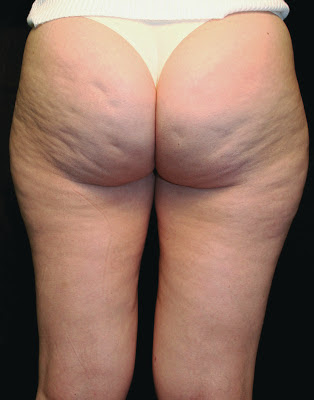
The underlying architecture of the subcutaneous fat is the cause of the visible change. There is herniation of fat deposits in between fibrous connective tissue strands. Almost like a honey cone where the honey represents the fat and the cone the fibrous septa.
I
get asked about solutions and treatments for this skin appearance on a
daily basis. It rears its head in many forms and severities from mild
dimpling to severe orange-peel effect.


mild cellulite only on compression visible without compression

mild cellulite only on compression visible without compression
The underlying architecture of the subcutaneous fat is the cause of the visible change. There is herniation of fat deposits in between fibrous connective tissue strands. Almost like a honey cone where the honey represents the fat and the cone the fibrous septa.
CELLULITE is almost exclusively found in women, although occasionally seen in men on hormone treatment. We see it most commonly in post-pubescent women.
Scientific evidence is still scanty on the exact cause and related factors, but we know that oestrogen hormone plays a large role. Other factors include genetics, lifestyle, diet, weight (esp. raised BMI). Some of these factors we can obviously change, but others not.
Treatments
At this stage there are no specific treatments that can conclusively eliminate cellulite. External treatments that promise to eliminate cellulite are not very successful and result in many post-treatment tears and disappointment. The vital ingredient of any cellulite-busting treatment will be to remove the fibrous septae.
I am working on a novel treatment that is minimally invasive and involves separating the fibrous strands under local anaesthetic. The results look promising, but we are waiting for longer term results to offer this treatment confidently. WATCH THIS SPACE...........
Come see our website www.DrWolf.com
Tuesday, 18 June 2013
Visceral FAT and VASER
As the majority of my work consists of body contouring I see many patients that spend many months and even years in the gym trying to get rid of unwanted fat. This is often combined with healthy diet and lifestyle.
Occasionally patients have only recently changed their lifestyle and attitude towards exercise and become really frustrated when they see no change in their shape or contour. In many cases seeing a nutritionist (here is an excellent one by the way) can be of great value in tweaking your diet and eating routine. Most can also assess your food intolerances which may be contributing to the sensation of bloatedness and give you advice on combinations of foods. Money well worth spent.
If fat has accumulated over a few years then its most likely visceral fat. An excess of visceral fat
is known as central obesity, the "pot belly" or "beer belly" effect, in
which the abdomen protrudes excessively (see picture).
This body type is also known
as "apple shaped‚" as opposed to "pear shaped‚" in which fat is
deposited on the hips and buttocks (more commonly seen in women).
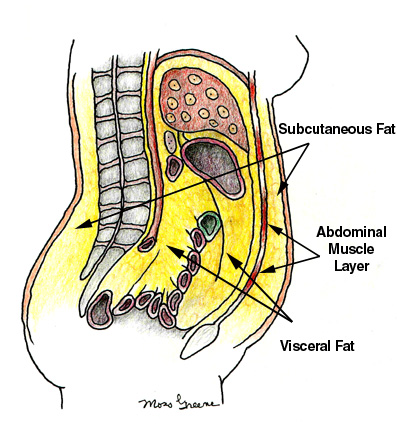
This is not in the superficial layer under the skin but fat that has been deposited around your organs (see figure below).
With any form of VASER, liposuction or fat removal this can only be performed in the subcutaneous fat layer. One cannot enter the abdominal cavity under the muscle.
This fat content unfortunately only responds to weight loss and changes in diet and lifestyle. And yes, it responds VERY SLOWLY and this is why many patients become so frustrated. When treating patients with significant amount of visceral it is imperative that they agree to make lifestyle modifications and diet changes. Subcutaneous fat removal can help and may speed up the loss of visceral fat, but only in conjunction with the above.
Visceral fat has many health implications. There is a strong connection to cardiovascular disease, diabetes, and dyslipidemia. Central obesity plays an important role in the impairment of lipid and carbohydrate metabolism shown in high-carbohydrate diets. Diet modifications and lifestyle CHANGES ARE THIS VITAL.
In summary, results are achievable, however, it is not easy and requires a combination of angles of attack. See what exercises are worth considering.....
Subscribe to:
Posts (Atom)